
How Your Gut Microbiome Ages — And What You Can Do to Slow It Down
By Dr. Chomba Chuma, MD | Velo16™ Health Journal
There is a quiet transformation happening inside every one of us — one that begins decades before we notice its effects. Your gut microbiome, the vast and complex ecosystem of trillions of bacteria, fungi, viruses, and other microorganisms living in your digestive tract, does not remain static throughout your life. It ages alongside you. And as it ages, its ability to protect your health gradually, almost imperceptibly, erodes.
For most of us, the conversation about ageing focuses on what we can see: the greying hair, the slower recovery after exercise, the reading glasses that appear on the bedside table. But the most consequential changes are happening at a microscopic level — deep in your gut, where the balance of microbial life shapes your immune function, your inflammation levels, your cognitive clarity, and even how long you live.
As a functional medicine physician, I have spent years studying the intersection of gut health and healthy ageing. The research is both sobering and empowering. Yes, microbiome ageing is real and significant. But it is also, to a meaningful degree, modifiable. This article is your evidence-based guide to understanding how your gut changes after 50 — and the targeted probiotic and lifestyle protocol that can help you maintain vitality, resilience, and wellbeing well into your later decades.
1. The Ageing Gut: What the Science Actually Shows
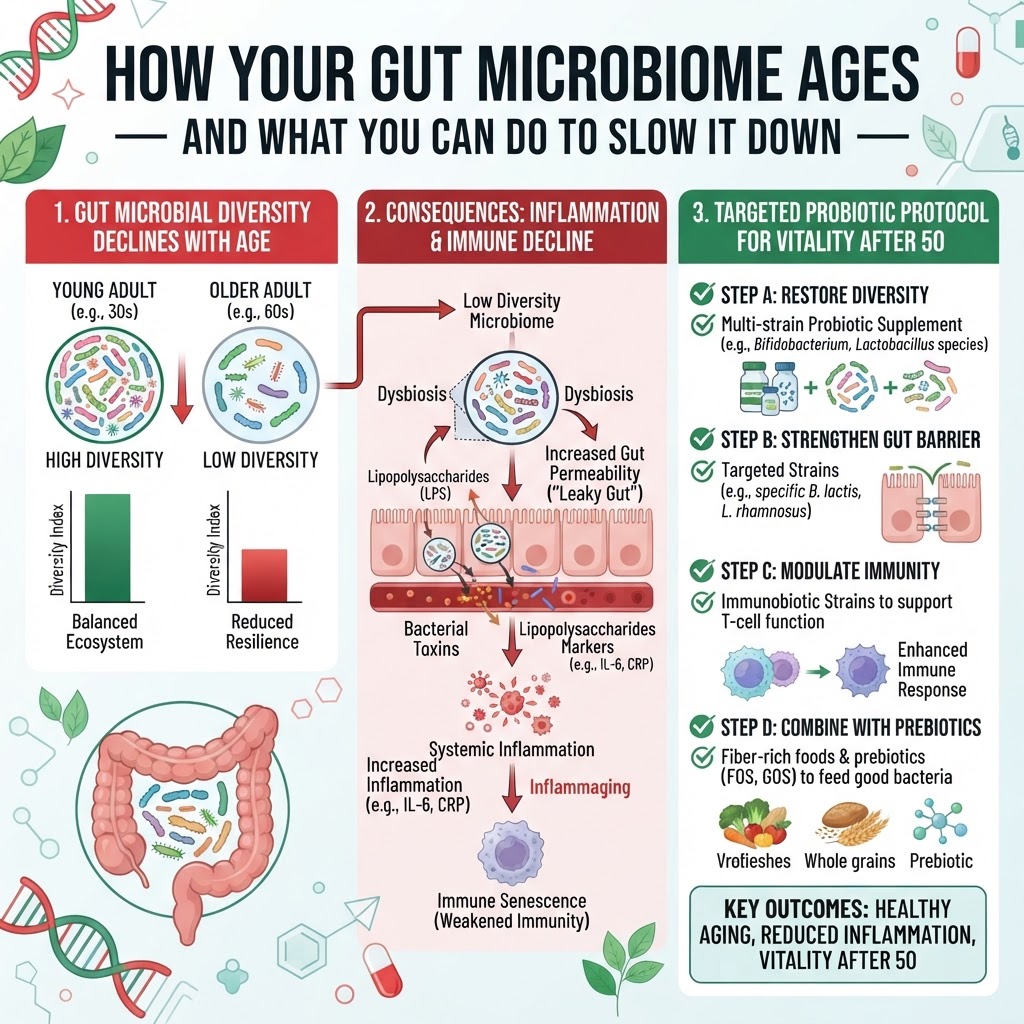
Let us begin with the biology. A healthy gut microbiome in a young adult is characterised by extraordinary diversity — hundreds of different bacterial species coexisting in a dynamic, mutually beneficial ecosystem. This diversity is not merely aesthetic. It is functionally critical. Different species perform different tasks: fermenting dietary fibre into protective short-chain fatty acids, synthesising B vitamins and vitamin K, training the immune system, protecting the gut lining, and producing neurotransmitters that influence mood and cognition.
Research published in Nature Microbiology and corroborated by multiple large-cohort studies has confirmed a consistent pattern: as we age, microbial diversity declines. The microbiomes of adults over 65 show markedly reduced species richness compared to younger adults, with a measurable shift in the ratio of beneficial to potentially harmful bacterial communities.
The Key Microbial Shifts After 50
Several specific changes define the ageing gut microbiome:
- Decline in Bifidobacterium species: These are among the most important beneficial bacteria in the gut, particularly for immune modulation and the production of short-chain fatty acids. Bifidobacterium populations can fall by as much as 1,000-fold between young adulthood and old age.
- Decline in Lactobacillus species: Associated with gut barrier integrity and anti-inflammatory activity, Lactobacillus populations also diminish significantly with advancing age.
- Increase in pro-inflammatory bacteria: Species from families such as Proteobacteria — many of which produce lipopolysaccharides (LPS), potent inflammatory molecules — tend to increase as beneficial species decline.
- Reduced production of short-chain fatty acids (SCFAs): Particularly butyrate, propionate, and acetate — molecules that fuel the cells lining the gut wall, reduce intestinal permeability, and regulate immune responses.
- Increased intestinal permeability: Commonly referred to as "leaky gut," this occurs when the tight junctions between gut lining cells weaken, allowing bacterial fragments and toxins to enter systemic circulation.
A landmark study in the Journal of Clinical Gastroenterology noted that these microbial shifts are not merely passive reflections of ageing — they are active drivers of the systemic inflammation and immune dysregulation that characterise the ageing process.
Why Does the Microbiome Age in the First Place?
This is a question I am frequently asked in clinical practice. The causes are multifactorial:
- Dietary changes: Many older adults reduce dietary fibre intake, which deprives beneficial bacteria of their primary fuel source.
- Reduced digestive enzyme production: Stomach acid and enzyme secretion naturally decline, altering the gut environment.
- Polypharmacy: Older adults are more likely to take multiple medications, including antibiotics, proton pump inhibitors, and statins, which significantly disrupt microbial balance.
- Reduced physical activity: Exercise is a powerful modulator of microbiome diversity; its reduction accelerates dysbiosis.
- Social and lifestyle changes: Social isolation, reduced dietary variety, and altered sleep patterns all negatively affect the microbiome.
- Immune system changes: The ageing immune system (immunosenescence) itself creates a less hospitable environment for beneficial microbes.
"The microbiome is not just a passenger in the ageing process — it is a driver. Declining microbial diversity accelerates inflammageing, immune dysfunction, and metabolic decline, creating a feedback loop that compounds over time."
2. Inflammageing: When Your Gut Drives Chronic Inflammation
One of the most significant concepts to emerge from ageing research in the past two decades is inflammageing — a term coined by immunologist Claudio Franceschi to describe the chronic, low-grade, sterile inflammation that characterises biological ageing. Unlike the acute inflammation you experience when you cut your finger, inflammageing is persistent, systemic, and largely silent — until it is not.
The World Health Organization identifies chronic inflammation as a central driver of the major non-communicable diseases of later life, including cardiovascular disease, type 2 diabetes, cognitive decline, and cancer. And your gut microbiome is one of the most powerful regulators — or dysregulators — of this inflammatory state.
The Gut-Inflammation Feedback Loop
Here is how the cascade works in practice:
- Beneficial bacterial populations decline, reducing the production of anti-inflammatory short-chain fatty acids.
- Intestinal permeability increases, allowing lipopolysaccharides (LPS) from gram-negative bacteria to enter the bloodstream.
- Circulating LPS activates toll-like receptors on immune cells, triggering an inflammatory response.
- Chronic activation of this pathway produces elevated levels of pro-inflammatory cytokines — particularly TNF-alpha, IL-1β, and IL-6.
- This systemic inflammatory state accelerates cellular ageing, impairs metabolic function, and increases risk for virtually every chronic disease of later life.
- The resulting immune dysfunction further disrupts microbial balance, perpetuating the cycle.
Research from Harvard Health Publishing has also highlighted the gut-brain axis as a critical pathway through which microbiome dysbiosis contributes to cognitive decline, depression, and anxiety in older adults. The gut produces approximately 95% of the body's serotonin — and an ageing, dysbiotic gut is a significantly less effective serotonin factory.
Senior Immune Support: The Microbiome Connection
Approximately 70-80% of the immune system is housed in and around the gut. This is not coincidental — it reflects the evolutionary reality that the gut is the largest surface through which the body interfaces with the external environment. Your gut-associated lymphoid tissue (GALT) is in constant communication with your microbiome, using microbial signals to calibrate immune responses.
When the microbiome ages and diversifies poorly, this calibration falters. The immune system becomes simultaneously over-reactive (driving inflammation) and under-responsive (less able to mount effective defences against pathogens and malignant cells). This dual dysfunction — immunosenescence combined with inflammageing — is one of the primary mechanisms through which gut health over 60 becomes so consequential for overall health outcomes.
3. The Evidence for Probiotics in Healthy Ageing
Given the central role of microbiome decline in driving the pathologies of ageing, the logical question is: can we restore or maintain microbial diversity through targeted supplementation? The answer, supported by a growing body of rigorous clinical evidence, is yes — with important nuance.
Not all probiotics are created equal. The research on probiotics for seniors specifically underscores that strain selection, colony-forming unit (CFU) count, and delivery mechanism all profoundly influence clinical outcomes. This is a principle we have built into the design of the Velo16™ Healthy Ageing Collection from the ground up.
What the Clinical Research Shows
A 2019 systematic review published on PubMed/NCBI examining 17 randomised controlled trials found that multi-strain probiotic supplementation in adults over 60 produced statistically significant improvements in:
- Markers of intestinal permeability (reduced zonulin and LPS levels)
- Inflammatory cytokine profiles (reduced IL-6 and TNF-alpha)
- Bifidobacterium and Lactobacillus abundance in stool samples
- Self-reported digestive comfort and bowel regularity
- Immune response markers, including secretory IgA levels
A separate study in Nature Microbiology demonstrated that specific Lactobacillus and Bifidobacterium strains were capable of producing measurable increases in short-chain fatty acid production within 8 weeks of supplementation in older adults — a finding with profound implications for gut barrier integrity and immune function.
The Role of Prebiotics: Feeding the Right Bacteria
Probiotics do not work in isolation. For probiotic bacteria to colonise and thrive, they need a suitable substrate — dietary fibres that serve as their food source, collectively known as prebiotics. The combination of prebiotics and probiotics, known as synbiotics, consistently outperforms probiotics alone in clinical trials.
This is why the Velo16™ Senior Vitality formulation incorporates prebiotic fibres alongside our carefully selected probiotic strains — a design choice grounded in the mechanistic science of how beneficial bacteria actually take hold and produce lasting benefit in the ageing gut. You can explore the full rationale behind our formulation approach on The Velo16™ Science page.
Key Strains for the Ageing Gut
When evaluating probiotics for healthy ageing in South Africa and globally, the following strains have the most robust evidence base in older adult populations:
- Bifidobacterium longum: Supports intestinal barrier function, reduces inflammatory markers, and has demonstrated efficacy in improving bowel regularity in older adults.
- Bifidobacterium lactis (BB-12): One of the most clinically studied strains for immune modulation, with evidence for enhanced NK cell activity and improved vaccine response in seniors.
- Lactobacillus rhamnosus (GG): Extensively studied for gut barrier support, anti-inflammatory effects, and resilience against pathogen colonisation.
- Lactobacillus acidophilus: Supports nutrient absorption and produces bacteriocins that inhibit the growth of pathogenic bacteria — particularly valuable as gastric acid production declines with age.
- Lactobacillus plantarum: Demonstrates potent anti-inflammatory effects and has shown promise in supporting cognitive function through the gut-brain axis in emerging research.
4. Your Targeted Protocol: Gut Health Over 60
Understanding the science is one thing. Implementing a practical, sustainable protocol is another. Based on both the clinical evidence and my experience working with patients in functional medicine practice, here is the framework I recommend for adults over 50 who are serious about ageing gut health.
Step 1: Foundation — High-Quality Multi-Strain Probiotics
Begin with a clinically dosed, multi-strain probiotic formulation designed specifically for the ageing microbiome. For probiotics healthy ageing South Africa context, it is important to choose a product that has been formulated and quality-controlled to survive the South African supply chain — temperature stability and encapsulation technology matter enormously here.
Look for a minimum of 10 billion CFUs per serving across at least 5-8 clinically studied strains, with verified shelf stability through to the expiry date (not just at time of manufacture). The Velo16™ Healthy Ageing Collection meets all of these criteria and is formulated specifically with the needs of South African adults in mind.
Step 2: Fuel — Prebiotic-Rich Dietary Habits
Your probiotic supplement will underperform significantly without adequate dietary prebiotic fibre to sustain your beneficial bacterial populations. Prioritise these foods daily:
- Jerusalem artichokes and chicory root — among the richest sources of inulin-type fructans
- Garlic and onions — accessible, versatile, and highly prebiotic
- Leeks and asparagus — excellent prebiotic content with minimal caloric load
- Green bananas and cooked-then-cooled potatoes — rich in resistant starch, a particularly valuable prebiotic for butyrate production
- Legumes (lentils, chickpeas, black beans) — affordable, widely available in South Africa, and excellent prebiotic and protein sources
- Oats — beta-glucan content provides prebiotic and immune-modulating effects
Step 3: Protect — Gut Barrier Support
Beyond probiotics and prebiotics, several additional nutrients play a direct role in maintaining the integrity of the gut lining that becomes increasingly important after 50:
- L-Glutamine: The primary fuel source for enterocytes (gut lining cells), with evidence for reducing intestinal permeability.
- Zinc: Essential for tight junction protein synthesis; deficiency is common in older adults and directly impairs gut barrier function.
- Vitamin D: A powerful immune modulator with direct effects on the microbiome; deficiency is extraordinarily common in South Africa despite our sunshine, particularly in darker-skinned adults and those who spend limited time outdoors.
- Omega-3 fatty acids: Reduce systemic inflammation and support a more diverse microbiome; oily fish (sardines, pilchards, mackerel) are excellent affordable sources.
Step 4: Remove — Identifying Microbiome Disruptors
Equally important as what you add is what you reduce or eliminate. The most significant microbiome disruptors in the over-50 population include:
- Unnecessary antibiotic use (discuss alternatives with your physician where clinically appropriate)
- Chronic proton pump inhibitor use without periodic reassessment
- Ultra-processed foods high in emulsifiers and artificial sweeteners — both shown to disrupt microbial balance in multiple studies
- Excessive alcohol consumption
- Chronic psychological stress (the gut-brain axis runs bidirectionally — stress devastates the microbiome)
- Sedentary behaviour: even 30 minutes of moderate daily movement produces measurable positive effects on microbiome diversity
"In my clinical experience, the most transformative outcomes come not from a single intervention but from layering targeted probiotic supplementation with dietary fibre, reduced ultra-processed food exposure, and consistent physical activity. The microbiome responds to the whole ecosystem of your lifestyle."
5. Ageing Well in South Africa: Contextual Considerations
As South Africans, we inhabit a unique health landscape. Our population is diverse, our dietary traditions are rich and varied, and our healthcare challenges are distinct. Several contextual factors are particularly relevant when thinking about gut health and healthy ageing in our context.
The South African Dietary Transition
Research from South African academic institutions has documented a significant "nutrition transition" in our population over the past three decades — a shift away from traditional plant-rich diets (high in legumes, fermented foods, and diverse vegetables) toward ultra-processed, low-fibre Western-pattern diets. This transition has been accompanied by a parallel rise in metabolic disease, and emerging evidence suggests that microbiome disruption is a significant mediating mechanism.
This makes targeted probiotic supplementation for South African adults over 50 not merely beneficial but arguably essential as a compensatory strategy while dietary patterns are navigated in a challenging food environment.
Fermented Foods: Reclaiming Our Heritage
Traditional South African fermented foods — amasi (fermented milk), mahewu (fermented maize drink), and various fermented legume preparations — are genuine functional foods with probiotic properties. Re-incorporating these cultural foods where possible is both a health strategy and a reclamation of heritage. They can serve as complementary sources of beneficial bacteria alongside a high-quality probiotic supplement.
Access and Affordability
We are acutely aware that healthcare in South Africa is not equitably distributed. At Velo16™, we are committed to making evidence-based supplementation accessible. Visit our Shop All Velo16™ Products page to explore our full range and find the right fit for your needs and budget. We also offer educational resources for healthcare providers working in underserved communities.
6. Measuring Progress: How to Know Your Gut is Responding
One of the most common questions I receive is: how do I know if my probiotic protocol is working? While comprehensive microbiome testing (stool analysis) is available and can be informative, it is not always accessible or necessary. There are reliable clinical indicators that your ageing gut health is improving:
Early Signs (Weeks 2–4)
- Improved bowel regularity and stool consistency
- Reduced bloating and abdominal discomfort
- Better appetite and reduced post-meal fatigue
- Improved sleep quality (the gut-brain axis mediates sleep regulation)
Intermediate Signs (Weeks 6–12)
- Improved energy levels and reduced afternoon fatigue
- Enhanced mood stability and cognitive clarity
- Fewer upper respiratory infections or faster recovery when they occur
- Improvements in skin clarity (the gut-skin axis is closely connected — explore this further with our Take the Clear Skin Quiz)
Longer-Term Indicators (3–6 Months)
- Improved inflammatory markers on blood testing (hsCRP, ESR)
- Better metabolic parameters (fasting glucose, lipid profile)
- Enhanced physical performance and reduced recovery time
- Overall subjective sense of vitality and resilience
For more articles on gut health, immunity, and evidence-based wellness, browse the Velo16™ Health Journal — our growing library of clinician-authored content designed to empower your health decisions.
Frequently Asked Questions
At what age should I start taking probiotics for healthy ageing?
The microbiome begins showing measurable age-related changes as early as the mid-30s, with more significant shifts occurring after 50. I generally recommend that adults begin a quality probiotic protocol in their 40s as a preventive strategy, and certainly by 50. However, it is never too late to start — clinical trials have demonstrated meaningful microbiome improvements in adults well into their 70s and 80s with consistent, targeted probiotic supplementation.
How long do probiotics take to work in older adults?
Most people notice initial improvements in digestive comfort within 2–4 weeks. More substantive changes — improved immune function, reduced inflammatory markers, enhanced energy — typically become apparent at the 6–12 week mark. For lasting benefit, probiotics should be viewed as an ongoing component of a healthy ageing protocol rather than a short-term intervention. Consistency is the most important predictor of outcome.
Are probiotics safe for seniors taking multiple medications?
For the vast majority of older adults, high-quality probiotic supplements are very well tolerated and safe alongside most medications. However, individuals who are severely immunocompromised (for example, those on immunosuppressive therapy following organ transplantation) should consult their physician before starting probiotics. There are also some theoretical interactions worth discussing with your doctor if you are on warfarin or certain immunomodulatory drugs. For most healthy older adults, the safety profile of evidence-based probiotic strains is excellent.
Should I take probiotics with food or on an empty stomach?
The research suggests that probiotic survival through the gastrointestinal tract is generally superior when taken with or just before a meal containing some fat — this helps buffer stomach acid and provides a more hospitable transit environment. However, the most important variable is consistency: taking your probiotic at the same time each day, whatever works best for your routine, will outperform any theoretical benefit of timing optimisation if it means you are more likely to remember and adhere to the habit.
What makes Velo16™ Senior Vitality different from standard probiotic supplements?
Velo16™ Senior Vitality is formulated specifically for the ageing gut microbiome, with strain selection, CFU counts, and synbiotic design based on clinical evidence in older adult populations — not generic formulations repurposed for seniors. Our products are manufactured to pharmaceutical-grade quality standards, with verified shelf stability in South African conditions, and are designed with the specific physiological changes of the ageing digestive system in mind. You can explore the detailed science behind our formulation approach on The Velo16™ Science page.
Ready to Invest in Your Gut Health — and Your Future?
Your microbiome does not have to age as fast as the calendar suggests. With the right probiotic protocol, dietary strategy, and lifestyle support, you can meaningfully shift the trajectory of your gut health — and with it, your energy, immunity, cognitive function, and overall vitality in the years ahead.
The Velo16™ Senior Vitality formulation was developed for exactly this purpose: to give South African adults over 50 a clinically grounded, locally optimised tool for maintaining the microbial diversity and gut barrier integrity that underpin healthy ageing.
Explore the Velo16™ Healthy Ageing Collection → | Shop All Velo16™ Products → | Read the Science →
Because ageing well is not about luck. It starts in your gut.