

Packing for Takeoff? The South African Traveller's Guide to Buying Velo16 Travel-Friendly Probiotic Capsules Online
Whether you're flying to Cape Town for a weekend, road-tripping to the Kruger, or heading overseas, travel has a well-documented way of upsetting digestion. Different water, different food timing, cramped economy seats and disrupted sleep all place pressure on your gut microbiome. Many South Africans now search for ways to buy Velo16 travel-friendly probiotic capsules online before a trip, and for good reason.
This guide unpacks why travel is uniquely hard on your gut, what actually makes a probiotic "travel-friendly", and the simple checklist to follow before you order and pack your capsules.
Why Travel Disrupts Your Gut Microbiome
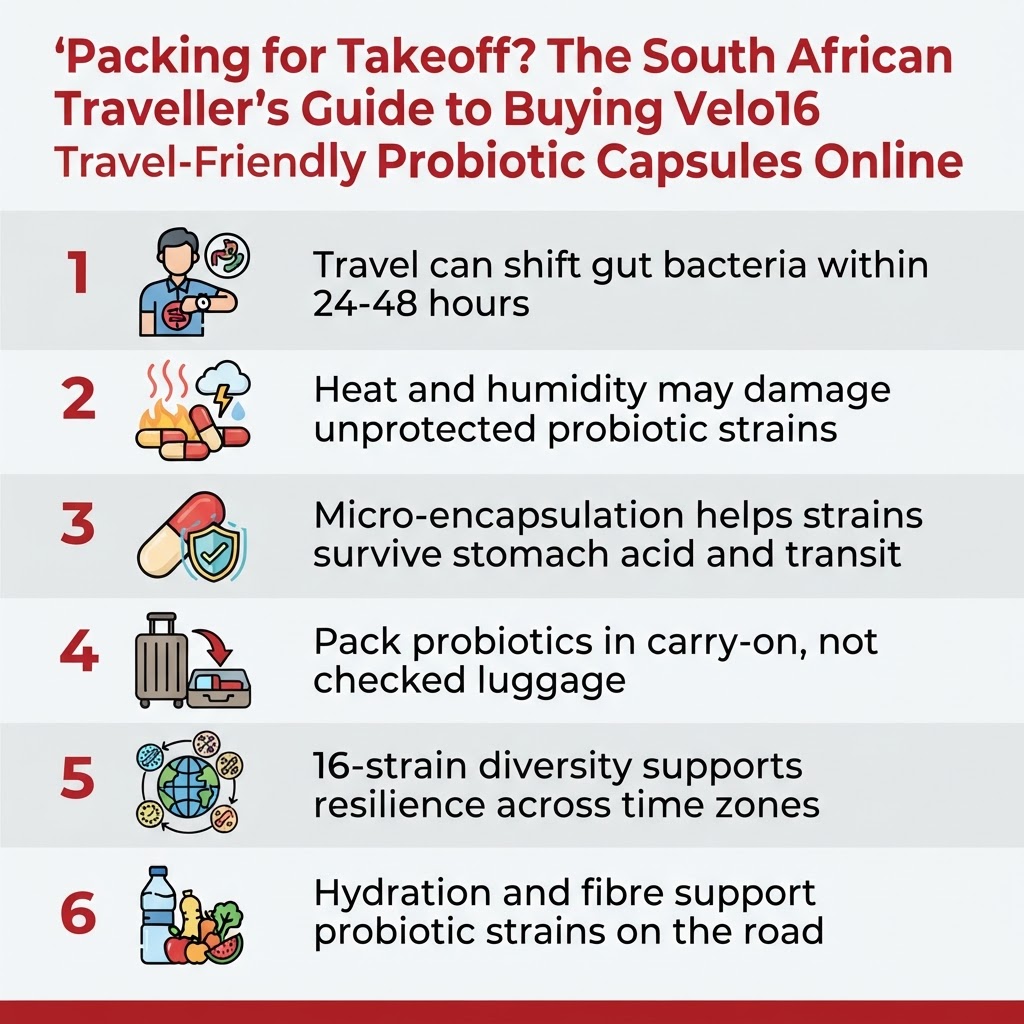
Your gut microbiome is remarkably adaptable, but it is also sensitive to sudden environmental change. Long-haul flights, new time zones, unfamiliar food and disrupted sleep schedules can all shift the balance of bacteria living in your digestive tract. Research published via the National Institutes of Health has highlighted how quickly travel-related factors can alter gut microbial composition, sometimes within just a day or two.
"Even short-term travel can produce measurable shifts in gut microbial diversity, particularly when diet, sleep and time zones change simultaneously."
- Summary of findings, PubMed-indexed microbiome research
This is part of why so many travellers land feeling bloated, sluggish or "off", even before accounting for jet lag. Supporting your gut proactively, rather than reactively, is a strategy many frequent flyers now build into their packing routine.
The Hidden Challenges of Taking Probiotics Abroad
Not all probiotic capsules are designed to handle the realities of travel. Heat in a checked suitcase, humidity at a coastal destination, or hours spent in a hot car can degrade unprotected strains before they ever reach your gut.
Common travel-related probiotic pitfalls
- Capsules left in direct sun or a hot vehicle glovebox
- Strains that require refrigeration, which isn't always available
- Loose pills without moisture protection in humid climates
- Running out mid-trip with no easy way to reorder locally
This is exactly why formulation matters as much as the strain count. A probiotic that performs well in a climate-controlled bathroom cabinet at home may behave very differently in a backpack crossing the Garden Route in midsummer.
What Makes a Probiotic Truly "Travel-Friendly"?
A genuinely travel-friendly probiotic needs to survive three journeys: the trip in your luggage, the trip through stomach acid, and the trip to your intestines where it can actually do its work. This is where micro-encapsulation technology plays a meaningful role.
We've detailed the science of this protective barrier before in our breakdown of SCO2 micro-encapsulation, but in short: a well-encapsulated capsule is designed to shield live strains from heat, moisture and stomach acid until they reach the gut.
"Microencapsulation techniques are increasingly used to improve the survival of probiotic strains during storage and gastrointestinal transit."
- Review summary, peer-reviewed food science literature
Strain diversity also matters. A broader 16-strain blend, rather than a single-strain capsule, offers more resilience when your routine, diet and sleep are all disrupted at once, which is precisely what happens on most trips.
Packing Smart: A Pre-Trip Gut Health Checklist
Before you order your travel supply, it helps to think through the logistics the same way you would with any other essential medication or supplement.
- Order with enough lead time for shipping before departure
- Keep capsules in your carry-on, not checked luggage
- Choose a formula that doesn't require refrigeration
- Pack slightly more than you think you'll need, in case of delays
- Check your destination's rules on supplement imports if travelling internationally
If you want a deeper walkthrough of what to confirm before purchasing any 16-strain formula online, our 7-point checklist for buying a 16-strain microencapsulated probiotic covers the finer details, from batch testing to storage claims.
Traveller's Tummy, Antibiotics and Your Microbiome
Travellers' diarrhoea remains one of the most common health complaints among international travellers, according to the World Health Organization. It's frequently linked to unfamiliar bacteria in food or water, and in some cases leads to a short course of antibiotics abroad.
Antibiotics, while sometimes necessary, can disrupt the diversity of your gut flora, which is part of why so many travellers feel digestively "reset" for weeks after a trip that involved medication. Supporting your gut before, during and after a course of antibiotics is a topic we explore in more depth across our broader gut-recovery content on this journal.
Why prevention-minded travellers plan ahead
Rather than waiting for symptoms to appear mid-trip, many travellers now start a probiotic routine a week or two before departure. The idea is simple: give your gut a head start before the disruption of flights, new food and altered sleep begins.
Jet Lag, Sleep and the Gut-Brain Connection on the Road
Your gut and brain communicate constantly through what researchers call the gut-brain axis, and travel stress is a particularly good example of this link in action. Disrupted sleep from time zone changes doesn't just leave you tired, it can also influence appetite, mood and digestive comfort.
According to Mayo Clinic, jet lag symptoms often include both sleep disturbance and gastrointestinal upset, which tend to compound one another the longer the trip continues. A settled gut may support more comfortable adjustment to new time zones, even if sleep itself takes a few days to normalise.
For readers who want to understand this connection in more depth, our article on the gut-brain axis explains how microbiome signals can influence mood and focus well beyond the digestive tract.
How to Buy Velo16 Travel-Friendly Probiotic Capsules Online
Buying online for travel is straightforward once you know what to check. Look for a formula that lists its strain count clearly, explains its encapsulation method, and doesn't require cold storage, since most travel itineraries simply don't allow for a fridge.
- Confirm the product doesn't need refrigeration during transit
- Check that strain counts and CFU figures are clearly listed
- Look for independent batch or lab testing information
- Order early enough to allow for standard shipping times
- Consider a slightly larger pack size for longer trips
Velo16's 16-strain, micro-encapsulated formula was built with exactly this kind of portability in mind. You can view the current range and place an order through the Velobiotics online store ahead of your next trip.
Your Simple First Step Before You Fly
You don't need to overhaul your entire routine before a trip. The easiest starting point is simply ordering a travel-friendly, micro-encapsulated probiotic early enough to build a few days' buffer into your gut before departure. From there, pack it in your carry-on, take it consistently, and let your gut do the rest of the adjusting.
Browse the full Velo16 probiotic range online and choose the pack size that fits your next itinerary.
Want more practical, research-informed gut health guidance before your next trip? Subscribe to the Velo16 newsletter for new articles straight to your inbox.