
Raising Healthy Kids: Why the First 1000 Days of Gut Health Set the Foundation for Life
By Dr. Chomba Chuma, MD | Velo16™ Health Journal
Every parent wants to give their child the best possible start in life. We obsess over nutrition, sleep schedules, vaccinations, and developmental milestones. But one of the most powerful determinants of your child's long-term health — their gut microbiome — rarely gets the attention it deserves in the first critical years of life.
As a functional medicine physician, I've spent years studying the relationship between early microbiome development and lifelong health outcomes. What the science now tells us is both humbling and empowering: the gut ecosystem your child builds in their first 1000 days — from conception to roughly age two — lays the biological foundation for their immune system, brain development, metabolic health, and resilience to chronic disease for decades to come.
In this article, I want to walk you through what the research says about children's microbiome development, the modern threats disrupting that development in South African children today, and the evidence-based strategies — including targeted probiotics for kids — that can help protect and restore what nature intended.
What Is the Gut Microbiome and Why Does It Matter So Much in Childhood?
The gut microbiome is the vast community of trillions of microorganisms — bacteria, fungi, viruses, and other microbes — that live predominantly in the large intestine. In adults, this ecosystem weighs roughly 1.5 kilograms and contains more genetic material than the human genome itself. But in children, this ecosystem is not fixed. It is dynamic, impressionable, and profoundly shaped by the environment in those early years.
Research published in Nature Microbiology has demonstrated that the infant gut microbiome undergoes three distinct phases of development: a developmental phase (months 3–14), a transitional phase (months 15–30), and a stable phase (months 31–46). Each phase is characterised by different dominant microbial families, and disruptions at any stage carry downstream consequences.
Why does this matter? Because the gut microbiome doesn't just digest food. In children, it performs functions that are absolutely central to healthy development:
- Immune education: Approximately 70–80% of the immune system resides in the gut. The microbiome teaches immune cells to distinguish between harmless substances and genuine threats — a process critical for preventing allergies and autoimmune conditions.
- Gut-brain axis development: The microbiome communicates bidirectionally with the brain via the vagus nerve, influencing neurotransmitter production, behaviour, and cognitive development.
- Nutrient absorption and metabolism: Gut bacteria produce short-chain fatty acids (SCFAs), synthesise vitamins like B12 and K2, and regulate how efficiently children absorb iron, calcium, and other critical nutrients.
- Barrier function: A healthy microbiome reinforces the intestinal lining, preventing "leaky gut" — a condition increasingly linked to inflammation, allergies, and systemic illness in children.
"The microbiome acquired during early life is not just a passive bystander. It actively programmes immune responses, metabolic pathways, and even neurological development in ways that persist well into adulthood." — Nature Microbiology, 2019
How the Microbiome Is Built: The First 1000 Days
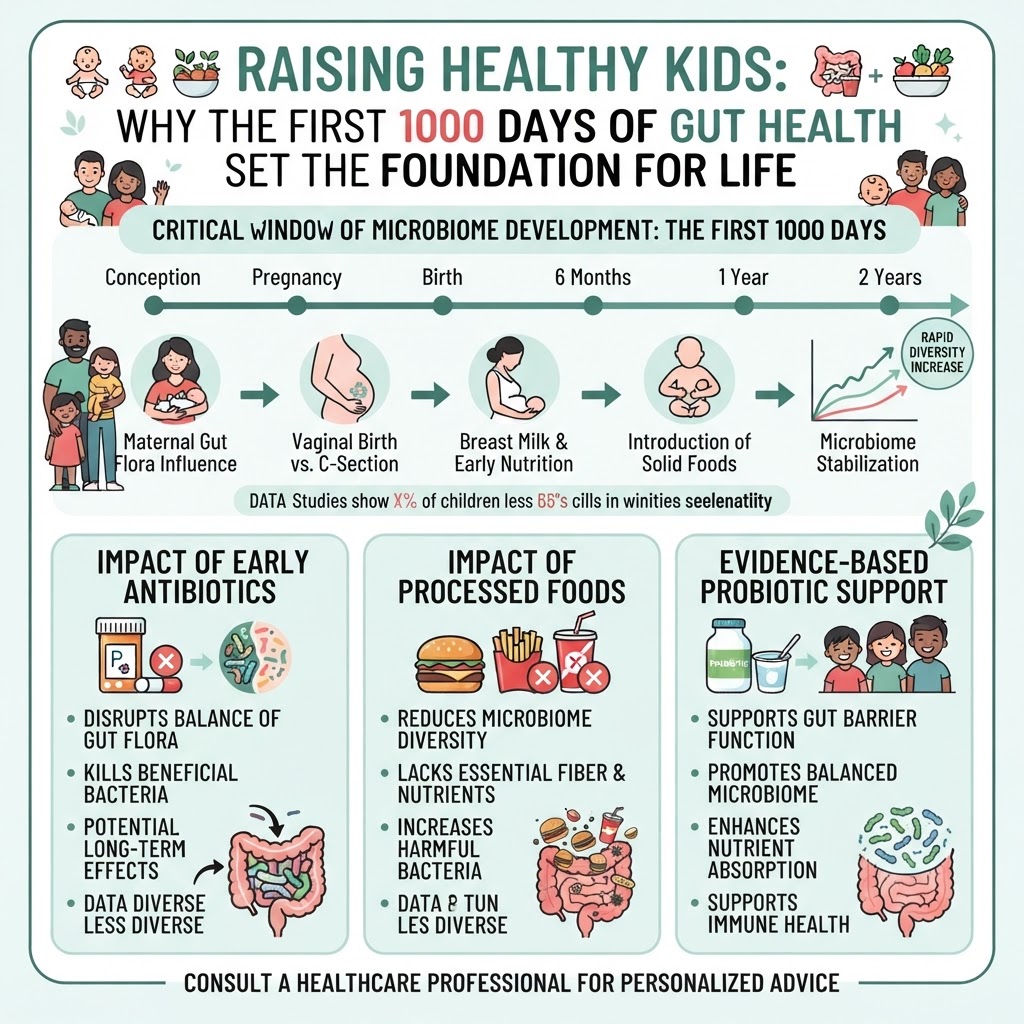
The first 1000 days — spanning from conception through the second birthday — represent a window of extraordinary biological plasticity. During this period, the gut microbiome is more malleable and more responsive to environmental inputs than at any other time in life. Understanding what shapes it helps us understand how to protect it.
Before Birth: The Prenatal Microbiome
For decades, the womb was considered sterile. We now know this isn't entirely accurate. Emerging research suggests that maternal gut bacteria can influence foetal development through the placenta and amniotic fluid, and that a mother's microbiome health during pregnancy directly affects what microbial "seed" a newborn starts with. Maternal stress, antibiotic use during pregnancy, and poor dietary diversity during gestation all reduce the richness of this initial microbial inheritance.
Birth Mode: A Foundational Fork in the Road
How a baby is born has a profound effect on their initial gut colonisation. Vaginally delivered infants are exposed to their mother's vaginal and faecal microbiota — specifically beneficial bacteria like Lactobacillus species — during passage through the birth canal. Infants born via caesarean section instead encounter skin and environmental bacteria, including potentially pathogenic Staphylococcus and Clostridium species.
A landmark study published in NCBI/PubMed found that caesarean-born infants had significantly reduced microbial diversity for up to six months compared to vaginally born peers, and showed higher rates of allergic sensitisation, asthma, and obesity in later childhood. In South Africa, where caesarean rates in private hospitals exceed 70% in some provinces, this is not a trivial concern.
Breastfeeding: Nature's Probiotic Delivery System
Human breast milk is one of the most complex biological fluids ever studied. Beyond its nutritional profile, breast milk contains human milk oligosaccharides (HMOs) — prebiotic fibres that selectively feed beneficial bacteria like Bifidobacterium — as well as live maternal bacteria, immunoglobulins, and growth factors that collectively shape the infant gut ecosystem.
The World Health Organization recommends exclusive breastfeeding for the first six months and continued breastfeeding alongside complementary foods for at least two years — not merely for nutritional reasons, but because of this extraordinary microbiome-shaping function.
Complementary Feeding and Dietary Diversity
When solid foods are introduced, typically from six months, the microbiome begins a rapid diversification. Fibre-rich plant foods, fermented foods, and dietary variety are the key drivers of microbial richness at this stage. Children introduced to a broad variety of whole foods in the first two years consistently demonstrate greater microbiome diversity — a metric strongly associated with better long-term immune and metabolic outcomes, according to research published in the Journal of Clinical Gastroenterology.
To learn more about how Velo16™ approaches children's health from a science-first perspective, visit The Velo16™ Science page.
Modern Threats to Children's Gut Health in South Africa
Despite what nature intends, the modern environment presents a series of powerful forces that disrupt children's kids digestive health and microbiome integrity. As a clinician seeing families across Johannesburg, I encounter these disruptions daily.
Antibiotic Overuse: The Single Biggest Threat
Antibiotics are among the most life-saving medicines ever developed. But their overuse — particularly in early childhood — is one of the most significant contributors to microbiome disruption we know of. A single course of broad-spectrum antibiotics can eliminate up to 30% of a child's gut bacterial species, and while some recovery occurs, research shows that full restoration may take months to years — if it happens at all.
A large population study cited by Harvard Health Publishing found that children who received three or more antibiotic courses before age two had significantly elevated risks of developing asthma, eczema, inflammatory bowel disease, and obesity in later childhood. In South Africa, antibiotic prescribing rates for childhood respiratory infections — many of which are viral and therefore unresponsive to antibiotics — remain concerningly high.
This doesn't mean antibiotics should be avoided when genuinely needed. It means that when antibiotics are prescribed, concurrent and post-treatment probiotic support is not optional — it is medically prudent.
Ultra-Processed Foods and the South African Diet
South Africa's urban food environment is increasingly dominated by ultra-processed foods: flavoured snacks, sweetened cereals, fast food, sugary beverages, and refined carbohydrates. These foods share a common microbiome-disrupting profile: low fibre, high sugar, high refined fat, and multiple artificial additives — emulsifiers, preservatives, and artificial colours — that research increasingly links to gut dysbiosis.
Emulsifiers such as carboxymethylcellulose and polysorbate 80, commonly found in processed children's foods, have been shown in preclinical studies to disrupt the protective mucus layer of the gut, directly altering microbial composition and promoting low-grade intestinal inflammation — a finding reported in Nature (via PubMed).
Environmental Exposures and the Hygiene Hypothesis
Paradoxically, excessively sanitised environments also pose a risk to microbiome development. The hygiene hypothesis — now evolved into the "old friends hypothesis" — proposes that reduced exposure to diverse environmental microorganisms in early childhood deprives the immune system of the microbial stimulation it needs to develop appropriate tolerance and regulatory responses.
Children raised in environments with limited outdoor exposure, excessive use of antibacterial products, and reduced contact with animals and soil show consistently lower microbiome diversity — and higher rates of allergic and autoimmune conditions — compared to children raised in more microbe-rich environments.
Stress and the Gut-Brain Axis in Children
Psychological stress — including household instability, academic pressure, trauma, and food insecurity — activates the hypothalamic-pituitary-adrenal (HPA) axis and alters gut motility, intestinal permeability, and microbial composition. Given the significant psychosocial stressors many South African children face, this pathway deserves greater clinical attention than it currently receives.
The Science of Probiotics for Kids: What the Evidence Actually Shows
The term probiotics for kids is often used loosely in marketing. As a physician, I believe parents deserve precise, evidence-based information rather than vague wellness claims. So let's look at what the research actually demonstrates.
Strain Specificity Matters Enormously
Not all probiotics are created equal, and this is especially true in paediatric applications. The benefits of any probiotic are strain-specific — meaning that clinical evidence for one bacterial strain does not transfer to another, even within the same species. When evaluating probiotic children South Africa options, the most important question is: has this specific strain been studied in children, for the specific outcome you're seeking?
The most extensively studied strains in paediatric research include:
- Lactobacillus rhamnosus GG (LGG) — extensively studied for prevention and treatment of antibiotic-associated diarrhoea and rotavirus diarrhoea in children
- Bifidobacterium longum subsp. infantis — dominant in breastfed infants; critical for HMO metabolism and early immune education
- Lactobacillus reuteri DSM 17938 — studied for infant colic, regurgitation, and early immune modulation
- Saccharomyces boulardii — a probiotic yeast shown to reduce duration of acute diarrhoea and support recovery of gut flora after antibiotic use
- Bifidobacterium animalis subsp. lactis BB-12 — linked to reduced incidence of respiratory infections and improved vaccine immune responses in children
Key Clinical Outcomes Supported by Evidence
A growing body of randomised controlled trials supports the use of specific probiotic strains in children for the following outcomes:
- Antibiotic-associated diarrhoea prevention: Meta-analyses consistently show that Lactobacillus rhamnosus GG and Saccharomyces boulardii reduce the risk of antibiotic-associated diarrhoea in children by 50–60%.
- Reduced frequency of upper respiratory infections: Several trials report that children receiving multi-strain probiotics experienced significantly fewer colds and respiratory illnesses per year compared to placebo groups.
- Atopic disease and eczema prevention: A Cochrane-reviewed PubMed meta-analysis found that probiotic supplementation during pregnancy and early infancy reduced the risk of eczema development by approximately 20%.
- Colic and gastrointestinal comfort: Multiple trials support L. reuteri in reducing crying time in colicky infants and improving general digestive comfort in toddlers.
- Vaccine immune response: Emerging research suggests that probiotic use enhances antibody responses to childhood vaccines by modulating gut-associated lymphoid tissue (GALT).
"Probiotic supplementation in children is no longer a fringe wellness recommendation. It is increasingly a mainstream clinical tool supported by high-quality evidence — when the right strains are used at the right doses." — Dr. Chomba Chuma, MD, Velo16™
The Kids Immune System Connection
Perhaps the most compelling reason to prioritise gut health in children is its direct relationship to the kids immune system. The gut-associated lymphoid tissue (GALT) — including Peyer's patches, mesenteric lymph nodes, and the appendix — is the largest immunological organ in the body. In children, whose adaptive immune systems are still being educated and calibrated, the microbial environment of the gut has an outsized influence on how the immune system learns to respond.
A diverse, balanced gut microbiome promotes the development of regulatory T cells (Tregs) that prevent excessive inflammatory responses — the immunological imbalance underlying allergies, asthma, eczema, and autoimmune conditions. Conversely, a dysbiotic gut — one depleted of beneficial bacteria and overpopulated with opportunistic species — skews immune development toward inflammatory, pro-allergic pathways.
Explore our full range of evidence-based support for children at the Velo16™ Children's Health Collection.
Practical Strategies for Supporting Your Child's Gut Health
Beyond supplementation, there are foundational lifestyle and dietary practices that support robust children gut health development. These are not optional add-ons — they are the non-negotiable foundations upon which any supplement sits.
Feed the Microbiome: Dietary Foundations
- Prioritise diversity: Aim for 30 different plant foods per week — fruits, vegetables, legumes, whole grains, nuts, and seeds. Each plant brings different fibres that feed different bacterial species.
- Include fermented foods: Age-appropriate fermented foods like plain yoghurt, kefir, and even traditionally fermented South African maize products support microbial diversity.
- Minimise ultra-processed foods: Reduce reliance on packaged snacks, sweetened cereals, and fast food — not by creating anxiety around food, but by building whole food habits from toddlerhood.
- Prioritise prebiotic foods: Foods like onion, garlic, bananas, oats, and cooked and cooled potatoes are rich in prebiotic fibres that selectively nourish beneficial gut bacteria.
Environmental Microbiome Exposure
- Allow outdoor play in natural environments — soil, grass, and nature exposure provides microbial diversity.
- Avoid excessive use of antibacterial soaps and hand sanitisers outside of necessary contexts.
- Pet ownership — particularly dogs — has been associated with greater indoor microbial diversity and lower rates of childhood allergies.
Antibiotic Stewardship
- Always confirm with your physician whether an antibiotic is truly indicated — many childhood ear and respiratory infections are viral.
- When antibiotics are genuinely necessary, begin a evidence-based probiotic regimen alongside them and continue for at least four weeks post-treatment.
- Never use leftover antibiotics or self-prescribe for children.
Why Velo16™ Kids Probiotics
At Velo16™, we developed our children's probiotic formulation on a single principle: strain specificity backed by paediatric clinical evidence. Our formula includes clinically studied strains at therapeutically relevant doses, in age-appropriate delivery formats that children actually take. We don't cut corners on CFU counts, and we don't include strains simply because they're inexpensive to manufacture.
For South African families navigating high antibiotic exposure rates, urban processed food environments, and significant psychosocial stressors, our Velo16™ Children's Health Collection was designed with your child's specific context in mind. Browse all our formulations at Shop All Velo16™ Products.
And for those navigating the intersection of gut health and skin concerns in growing children, our Take the Clear Skin Quiz can help identify whether the gut-skin axis may be driving your child's skin challenges.
Frequently Asked Questions
At what age can I start giving my child probiotics?
Probiotic use can begin from birth, and certain strains have been studied extensively in newborns and premature infants. However, the appropriate strain and dose depend on your child's age, health status, and specific need. Formulations appropriate for infants differ from those for toddlers and school-age children. Always consult your paediatrician before starting any supplement in children under 12 months, especially if the child has an underlying health condition or was born prematurely.
Do probiotics interfere with antibiotics?
No — in fact, taking probiotics alongside antibiotics is clinically supported. Probiotics should be taken 2–3 hours away from each antibiotic dose to minimise the chance of the antibiotic killing the probiotic organisms before they colonise. Evidence consistently shows that concurrent probiotic use reduces antibiotic-associated diarrhoea and supports faster microbiome recovery post-treatment.
How long should my child take probiotics?
This depends on the indication. For antibiotic recovery, a minimum of 4–8 weeks post-treatment is recommended. For ongoing immune support or management of recurrent infections, continuous daily use throughout the winter season or year-round is commonly practised and supported by safety data. Probiotics have an excellent long-term safety profile in healthy children. Speak with your functional medicine physician for personalised guidance.
Are there risks to giving children probiotics?
In healthy children, probiotics are very well-tolerated and have an excellent safety record. Minor, transient gastrointestinal symptoms (gas, bloating) may occur in the first few days as the gut adjusts. Probiotics should be used with caution — and only under medical supervision — in immunocompromised children, those with central venous catheters, or children with short bowel syndrome. For the vast majority of healthy children, evidence-based probiotic formulations carry minimal risk and meaningful benefit.
Can probiotics help with my child's eczema or allergies?
The gut-skin and gut-immune axes are well-established in the scientific literature. Evidence supports that specific probiotic strains — particularly Lactobacillus rhamnosus GG and combinations including Bifidobacterium species — can reduce the severity of atopic eczema in children and may lower the risk of allergic sensitisation when used early in life. Results are strain-specific and individual responses vary, but the evidence base is sufficiently strong that gut health intervention is a reasonable and evidence-supported component of an integrative approach to childhood atopy.
Give Your Child the Gut Health Foundation They Deserve
The science is clear: the first 1000 days of your child's gut health are too important to leave to chance. Whether you're navigating post-antibiotic recovery, building daily immune resilience, or simply investing in your child's long-term health, Velo16™ Kids Probiotics was formulated to support every step of the journey.
Explore our full paediatric range at the Velo16™ Children's Health Collection, or browse all our evidence-based formulations at Shop All Velo16™ Products.
For more evidence-based health insights, visit the Velo16™ Health Journal.