

Stressed, Wired and Bloated by 10pm? Why South Africans Are Ordering Velo16's Probiotics Ashwagandha Complex for Stress Balance
You get through the day on deadlines and coffee, then by evening your stomach is tight, your mind won't switch off, and sleep feels just out of reach. If this sounds familiar, you're not imagining the connection between a stressful day and an unsettled gut. It's a pattern many South Africans are trying to address with a more deliberate, everyday routine.
The Stress Spiral You Know Too Well
Work pressure, traffic, load shedding admin, family demands — modern stress rarely switches off. Over time, this steady low hum of pressure can show up physically: tense shoulders, shallow breathing, and a gut that feels unpredictable. Many people notice bloating, irregular digestion and a foggy, short-tempered mind all arriving together.
This isn't a coincidence. Your gut and your stress-response system are in constant conversation, and when one is under pressure, the other usually feels it too.
Stress can affect the body and mind in ways that go beyond mood, influencing digestion, sleep and immune function.
- World Health Organization, Stress Fact Sheet
What Happens in Your Gut When Stress Hits
When you're under pressure, your body activates the hypothalamic-pituitary-adrenal (HPA) axis, releasing cortisol to help you respond quickly. This is useful for short bursts of stress, like a near-miss on the highway. The problem is when that cortisol tap stays on for weeks or months at a time.
Sustained high cortisol is associated with changes in gut motility, the mucus lining of the intestines, and the balance of bacteria living there. Research on the gut-brain relationship continues to explore how disruption in one system can influence the other.
- Digestion may slow down or speed up unpredictably under chronic pressure
- The gut lining can become more reactive, which some people associate with bloating
- Sleep disruption from stress can further affect gut bacteria diversity
- Mental clarity often dips when the gut and nervous system are both under strain
If you want a deeper look at how the gut and brain communicate day to day, our earlier piece on the gut-brain axis and your mood, focus and memory covers the broader science in more detail.
Ashwagandha: The Adaptogen Backed by Research
Ashwagandha (Withania somnifera) is one of the most studied adaptogenic herbs, traditionally used in Ayurvedic practice and now explored in modern clinical research. Adaptogens are plant compounds thought to help the body manage stress more efficiently, rather than targeting one single symptom.
A frequently cited randomized controlled trial found that adults taking ashwagandha root extract reported lower perceived stress scores and reduced serum cortisol levels compared to a placebo group over 60 days.
High-concentration full-spectrum Ashwagandha root extract safely and effectively improves an individual's resistance towards stress and thereby improves self-assessed quality of life.
- Chandrasekhar et al., Indian Journal of Psychological Medicine, 2012
You can read the original study summary via PubMed. It's worth noting that research on adaptogens is ongoing, and individual responses vary, which is why Velo16 frames ashwagandha as a supportive addition to a daily routine rather than a fix-all.
Why It's Paired With Probiotics, Not Taken Alone
Ashwagandha on its own addresses the stress-response side of the equation. But if your gut bacteria are already out of balance from months of pressure, poor sleep or rushed meals, adding an adaptogen alone may not be enough. This is where a multi-strain probiotic comes in as a complementary layer.
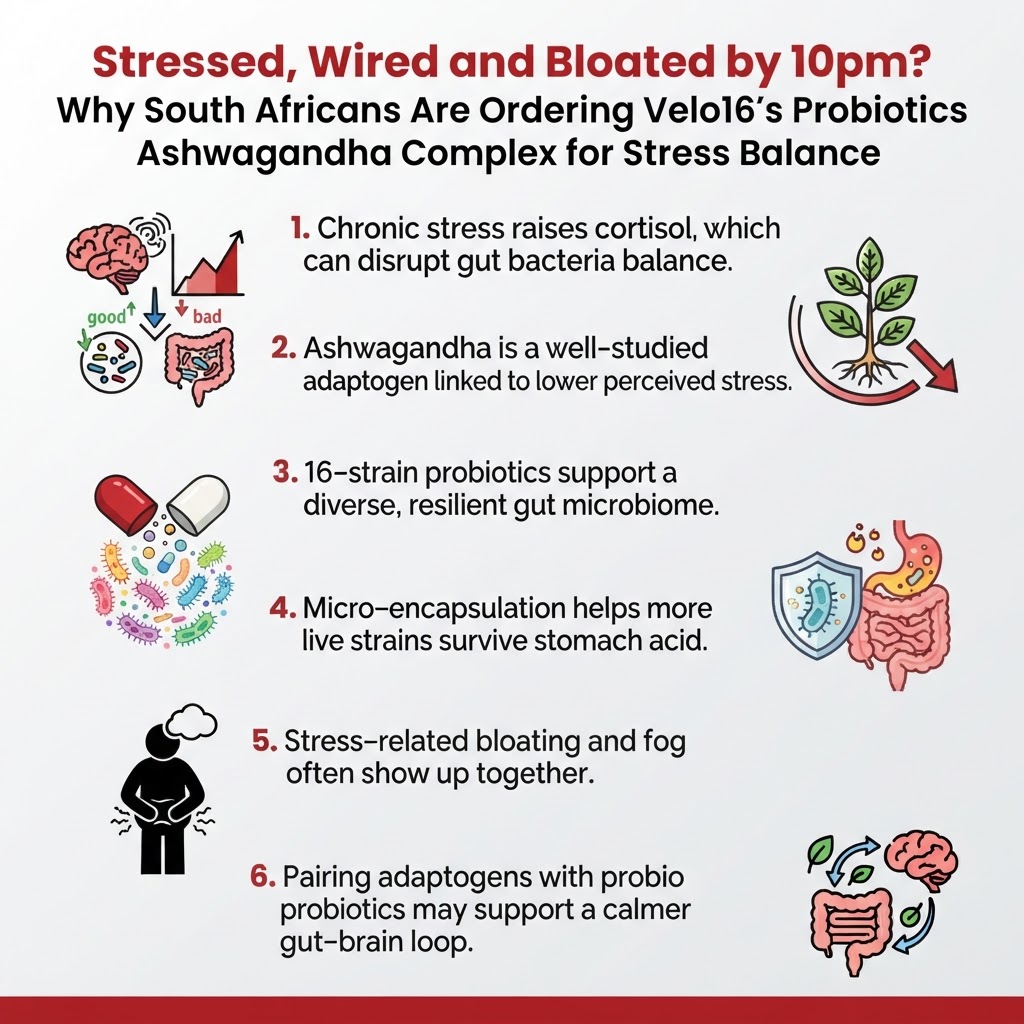
Why Pairing Ashwagandha With 16-Strain Probiotics Makes Sense
The idea behind combining an adaptogen with a broad-spectrum probiotic is simple: support the nervous system's stress response while also supporting the diversity of bacteria living in the gut. These two systems are thought to influence one another continuously through the vagus nerve, immune signalling and metabolic byproducts your gut bacteria produce.
Velo16's Probiotics Ashwagandha Complex was formulated around this dual approach, using 16 distinct bacterial strains alongside a standardised ashwagandha extract, housed in a patented micro-encapsulation shell designed to protect the probiotic strains as they travel through stomach acid.
- A wider range of strains may support a more resilient, diverse gut environment
- Micro-encapsulation is designed to help more live cultures reach the intestine
- Ashwagandha is included at a researched dose range, not a token amount
- The combination targets both the