

Probiotics vs Prebiotics: What's Really Inside Velo16's Multi-Strain Complex
If you've stood in a pharmacy aisle or scrolled an online store wondering why some bottles say "probiotic" and others say "prebiotic" — and a few say both — you're not alone. The two words sound similar, but they do completely different jobs in your digestive system. Understanding the difference is the single most useful thing you can learn before you buy any gut health supplement, including a multi-strain probiotic and prebiotic complex.
This article breaks down exactly what each ingredient does, why combining them (a strategy scientists call "synbiotic") may offer more complete support than either alone, and what that means practically for digestion, immunity, energy and the gut-brain connection.
Probiotics vs Prebiotics: Two Different Jobs, One Gut Goal
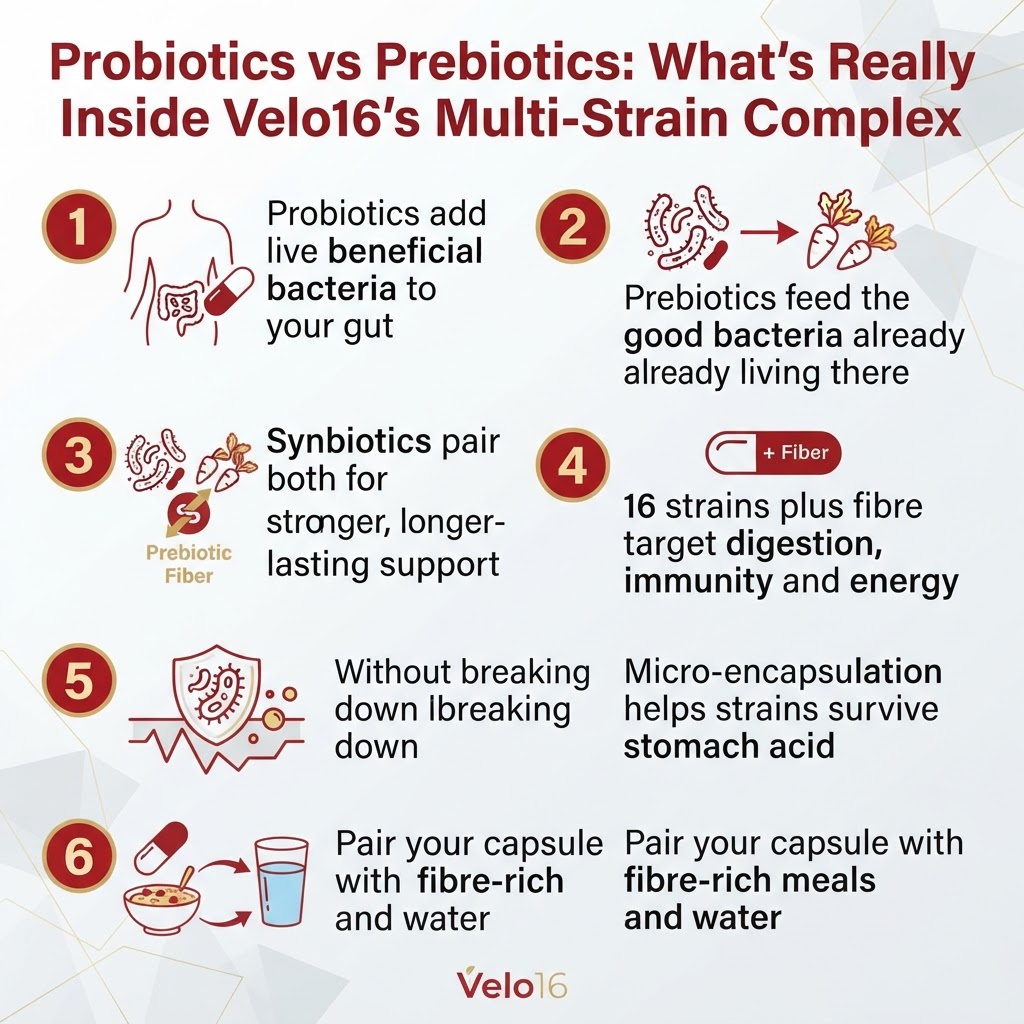
It helps to think of your gut as a garden. Probiotics are the seeds — live microorganisms that, when introduced in adequate amounts, may contribute to a more balanced gut microbiota. Prebiotics are the fertiliser — specific types of fibre that your body can't digest but that the beneficial bacteria already living in your colon can use as fuel.
What Probiotics Actually Do
- Introduce live bacterial strains (like various Lactobacillus and Bifidobacterium species) into the digestive tract
- May support a more diverse and resilient gut microbial community
- Are associated with digestive comfort, including reduced bloating in some studies
- Need protection from stomach acid to reach the intestines alive — which is where micro-encapsulation technology becomes relevant
What Prebiotics Actually Do
- Act as selective food sources for beneficial bacteria already in the gut
- Are typically fibres such as inulin, fructooligosaccharides (FOS) or galactooligosaccharides (GOS)
- Pass through the small intestine undigested and are fermented in the colon
- May help probiotic strains establish and multiply once they arrive
According to the International Scientific Association for Probiotics and Prebiotics (ISAPP), a prebiotic is formally defined as "a substrate that is selectively utilized by host microorganisms conferring a health benefit." This consensus statement, published in a widely cited scientific review, helped standardise how prebiotics are studied and labelled worldwide. You can read the full definition in the ISAPP consensus paper on PubMed.
"Prebiotics are not simply fibre — they are a specific category of fibre selected for their ability to be utilised by beneficial gut microorganisms."
- ISAPP Consensus Statement, 2017
Why Velo16's Complex Pairs 16 Strains With Targeted Prebiotic Fibre
A probiotic without food for the bacteria is a bit like releasing seeds onto bare rock. This is the logic behind combining multiple probiotic strains with a prebiotic fibre blend in a single capsule — giving the introduced bacteria both a presence and a reason to stay.
Velo16's flagship formula uses 16 distinct strains, each selected for a different role in the digestive ecosystem, alongside a prebiotic component designed to support those same strains once they reach the gut. If you want the full strain-by-strain breakdown, we've covered that in detail in 16 Strains, One Capsule: A Buyer's Breakdown of What's Actually Inside Velo16 Flagship Probiotics.
Why the Delivery Method Matters Just as Much as the Ingredients
Even the best-chosen strains and fibres are only useful if they survive the trip through stomach acid. This is where SCO2 micro-encapsulation becomes relevant — a packaging approach that aims to protect live cultures until they reach the intestines where they're meant to act. We explain the mechanics of this process in SCO2 Micro-Encapsulation Explained: A Practical Checklist Before You Buy Probiotics Online in South Africa.
Digestion, Bloating and the Synbiotic Advantage
Most South Africans who search for a gut health supplement are looking for one thing first: relief from bloating, irregularity or that heavy, sluggish feeling after meals. Research on combined probiotic-prebiotic formulations (often called synbiotics) suggests this pairing may offer more consistent digestive support than taking either ingredient on its own.
- Probiotic strains may assist with the breakdown of certain carbohydrates and fibres
- Prebiotic fibres can be gently fermented, which some people associate with reduced gas when introduced gradually
- A more stable gut environment is linked, in some research, to more regular bowel habits
- Combining both ingredients in one micro-encapsulated capsule may simplify a daily routine compared to taking separate products
If post-meal bloating is a regular frustration for you specifically, our deeper dive — Bloated After Every Meal and Never Sure Why? A Practical Buyer's Guide to Digestive Enzyme and Probiotic Complexes — goes further into enzyme support alongside probiotic strains.
"A balanced gut microbiota is associated with improved digestive comfort, and feeding beneficial bacteria with appropriate substrates is a reasonable strategy within a broader healthy diet."
- Mayo Clinic, Probiotics and Prebiotics FAQ
Immunity, Gut-Brain Axis and Energy: The Ripple Effect
Your gut doesn't operate in isolation — it's closely linked to your immune function, your mood regulation, and even your perceived energy levels throughout the day. This is partly because a large proportion of immune tissue is located in the gastrointestinal tract, and because gut bacteria produce metabolites that interact with the nervous system.
Immune Support
A well-fed, diverse gut microbial community is associated with more balanced immune signalling. The U.S. National Institutes of Health's National Center for Complementary and Integrative Health notes that probiotics are being studied for their potential role in supporting overall gut and immune balance, though research is still evolving for specific strains and conditions — you can read their overview at the NIH NCCIH probiotics fact page.
The Gut-Brain Connection
Fermentation of prebiotic fibres by gut bacteria produces short-chain fatty acids, which research associates with communication along the gut-brain axis. This is one reason combined probiotic-prebiotic approaches are of interest for everyday focus and mood support, a topic we explore further in The Gut-Brain Axis: How Your Microbiome Controls Your Mood, Focus and Memory.
Everyday Energy
When digestion is working efficiently, nutrient absorption tends to improve, which may indirectly support how energised you feel across the day. This is a gradual, cumulative process rather than an overnight change, so consistency matters more than any single dose.
After Antibiotics or Travel: When the Prebiotic Matters Most
Antibiotics are designed to eliminate harmful bacteria, but they can't distinguish between harmful and beneficial species — which is why gut balance often feels disrupted during and after a course of treatment. Travel, with its changes in water, food and routine, can have a similar, if milder, effect.
- Reintroducing live strains after antibiotics may help support microbial diversity during recovery
- A prebiotic fibre source can give those reintroduced strains something to feed on immediately
- Gradual reintroduction (rather than a sudden high dose) is generally better tolerated
- Hydration and fibre-rich meals alongside your capsule can support the process further
The World Health Organization continues to emphasise responsible antibiotic use precisely because of the broader impact on bacterial ecosystems, including those in the human gut — see their fact sheet on antibiotic resistance for context on why gut-conscious recovery matters.
What to Check Before You Buy a Multi-Strain Probiotic and Prebiotic Complex
Not every product labelled "probiotic and prebiotic" is formulated with the same care. Before adding one to your cart, a few practical checks can save you money and disappointment.
- Does the label specify the actual strains, not just a vague "probiotic blend"?
- Is there a defined prebiotic fibre listed, with a disclosed amount?
- Does the capsule use a delivery method designed to survive stomach acid?
- Is the CFU (colony-forming unit) count disclosed at the time of manufacture, not just at time of testing?
- Are storage and shelf-life instructions clear and realistic for South African conditions?
We've put together a full step-by-step version of this checklist in Ready to Order? The 7-Point Checklist for Buying a 16-Strain Microencapsulated Probiotic Online in South Africa, which is worth reading alongside this article before you finalise a purchase.
"Consumers should look for products that specify the exact bacterial strains used, as general claims without strain-level detail make it difficult to assess the evidence behind a product."
- Mayo Clinic, Probiotics and Prebiotics FAQ
Start Simple: Your Next Step
You don't need to overhaul your entire diet overnight to begin supporting your gut more intentionally. The simplest first step is choosing one well-formulated, micro-encapsulated multi-strain probiotic and prebiotic complex and taking it consistently, ideally with a meal, for several weeks before judging the results.
When you're ready to see the full range and compare options, you can explore the complete Velo16 collection here.
Want more practical, no-nonsense gut health guidance delivered straight to your inbox? Subscribe to the Velo16 newsletter for new research breakdowns, buyer's guides and seasonal gut health tips.