

Sunshine Country, Low Vitamin D: Why South Africans Are Adding Velo16's D3 Probiotic Blend to Their Winter Immune Routine
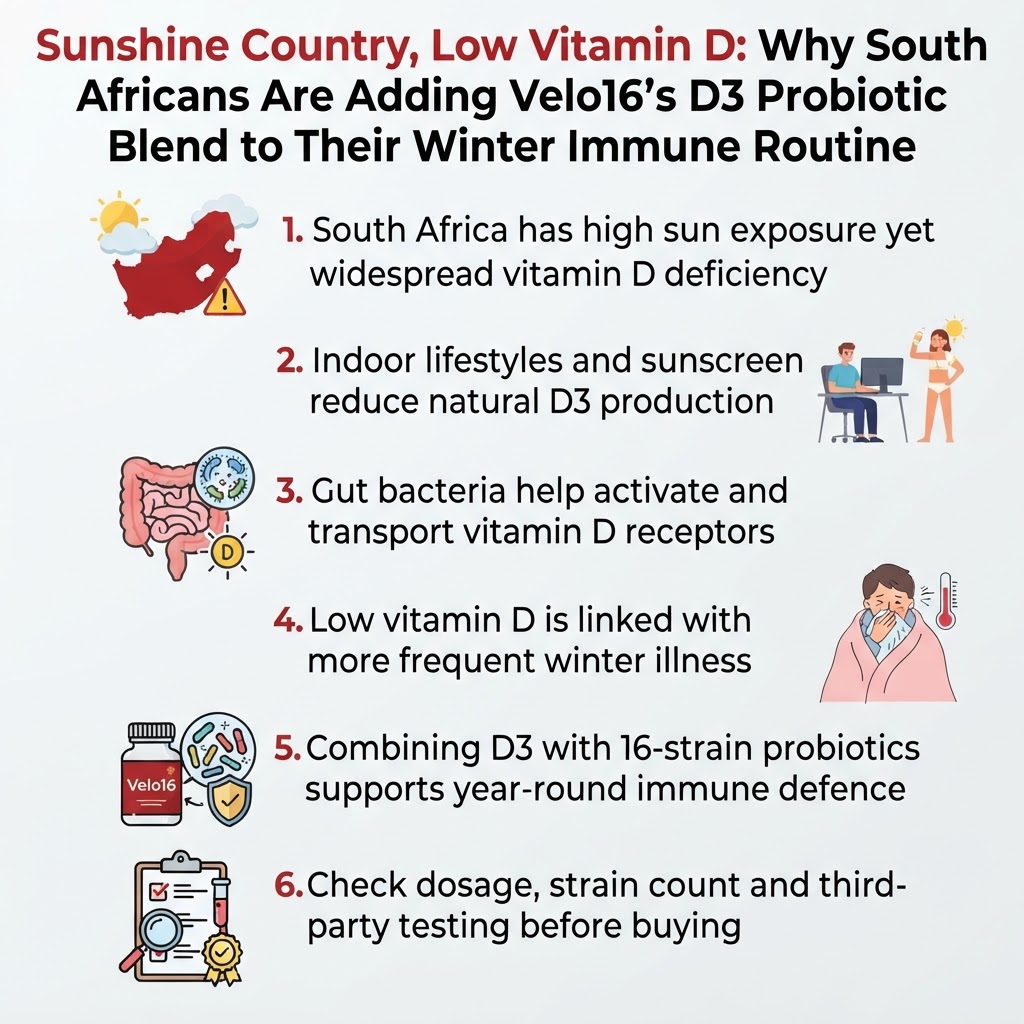
South Africa enjoys more than 2,500 hours of sunshine a year in most provinces, yet vitamin D deficiency remains surprisingly common. Indoor working hours, sunscreen use, higher melanin levels and urban living all reduce how much vitamin D our skin actually produces. As cold season approaches, many South Africans are looking more closely at the connection between this "sunshine vitamin" and their day-to-day immune resilience.
The South African Vitamin D Paradox
It sounds counterintuitive: a country famous for its sunshine, where a meaningful share of adults still test low on vitamin D. Office hours, load-shedding-driven indoor routines, and daily sunscreen application all limit the skin's ability to synthesise vitamin D from UVB rays. Add in winter's shorter days and lower sun angle, and even outdoorsy South Africans can see their levels dip.
According to Mayo Clinic, vitamin D plays a role in calcium absorption, bone health, and immune cell function, and deficiency is associated with increased susceptibility to common seasonal illness. This is why so many people search for ways to buy Velo16 probiotics vitamin D3 for immune defence rather than treating vitamin D as a stand-alone supplement.
Why Vitamin D3 Needs Gut Bacteria to Do Its Job
Vitamin D doesn't work in isolation. It needs to be converted into its active form and then recognised by vitamin D receptors found throughout the body, including on immune cells lining the gut. Emerging research suggests the gut microbiome influences how efficiently this conversion and receptor signalling happens.
"Vitamin D exerts its effects on both innate and adaptive immunity, and its receptors are expressed on most immune cells."
- Aranow C, Journal of Investigative Medicine, PubMed
You can read the full review on PubMed. In practical terms, this means a healthy, diverse gut microbiome may help the body use the vitamin D you're already taking more effectively, rather than D3 working in a vacuum.
The Vitamin D–Microbiome Connection
Several probiotic strains have been studied for their role in supporting gut barrier integrity, which is the first line of contact for roughly 70% of immune tissue. A stronger gut lining, supported by beneficial bacteria, may help the immune responses that vitamin D helps regulate function more smoothly. This is one reason Velo16 formulates its 16-strain probiotic alongside vitamin D3, rather than selling them as separate, unrelated products.
For a deeper look at how the gut and immune system interact day to day, see our earlier piece on how your immune system lives in your gut.
Who's Most at Risk This Cold Season
Not everyone is equally likely to run low on vitamin D, even in a sunny country. Certain lifestyle and demographic factors increase the risk significantly.
- People who work indoors for most daylight hours, including office and shift workers
- Individuals with darker skin tones, who need more sun exposure to produce the same amount of vitamin D
- Older adults, whose skin becomes less efficient at vitamin D synthesis over time
- Anyone who wears sunscreen consistently or covers most of their skin outdoors
- People already managing digestive discomfort, which may affect nutrient absorption
If several of these apply to you, it may be worth discussing vitamin D testing with a healthcare provider before cold season peaks.
What to Look for Before You Buy a Vitamin D3 Probiotic Combination
Not all supplements marketed for