
The Gut-Brain Axis: How Your Microbiome Controls Your Mood, Focus and Memory
By Dr. Chomba Chuma, MD | Velo16™ Health Journal
Have you ever felt that familiar knot in your stomach before a big presentation, or noticed how a rough week at work leaves you reaching for comfort food? That is not coincidence. That is biology — specifically, the gut-brain axis, one of the most profound and clinically significant communication networks in the human body. As a functional medicine physician, I have spent years studying how the health of your digestive system directly shapes the clarity of your thinking, the stability of your mood, and the sharpness of your memory.
What we now understand — backed by a rapidly growing body of research — is that your gut is far more than a digestive organ. It is, in very real terms, a second brain. And the trillions of microorganisms that live within it are, in many ways, pulling the strings. In this article, I want to walk you through the science of the gut mood connection, explain how your microbiome mental health link actually works at a neurochemical level, and show you why combining probiotics for focus with the extraordinary power of Lion's Mane mushroom may be one of the most impactful decisions you make for your cognitive health this year.
1. Understanding the Gut-Brain Axis: More Than a Metaphor
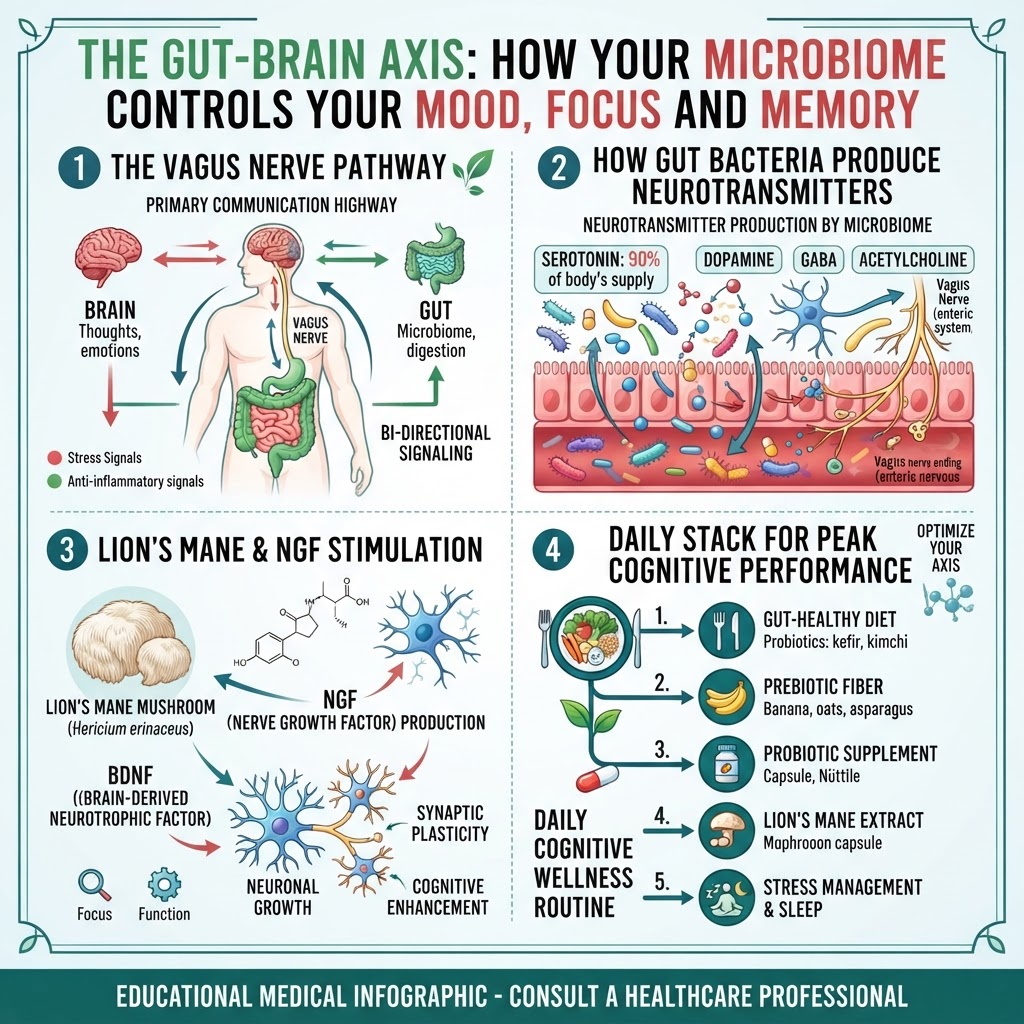
The gut-brain axis is the bidirectional communication highway connecting your central nervous system (CNS) — your brain and spinal cord — with your enteric nervous system (ENS), which governs the function of your gastrointestinal tract. This connection is physical, chemical, hormonal, and immunological. It is not a metaphor. It is a measurable, mappable system that neuroscientists, gastroenterologists, and psychiatrists are increasingly recognising as central to mental health.
"The gut-brain axis represents a paradigm shift in how we understand mental health. The idea that mood, cognition, and psychiatric conditions are purely 'brain disorders' is giving way to a far more integrated view of human physiology." — Nature Microbiology, 2019
At its core, the gut-brain axis operates through several key channels:
- The vagus nerve — the longest cranial nerve in the body, running from the brainstem to the abdomen
- Neurotransmitter production — chemical messengers synthesised in the gut
- The hypothalamic-pituitary-adrenal (HPA) axis — the body's central stress response system
- Immune signalling — cytokines and inflammatory markers that travel between gut and brain
- Short-chain fatty acids (SCFAs) — metabolites produced by gut bacteria that cross the blood-brain barrier
What makes this system so clinically relevant is that the majority of signals travel upward — from the gut to the brain — rather than the other way around. Approximately 90% of vagal fibres are afferent, meaning they carry information from the body to the brain. Your gut, in other words, is constantly whispering to your mind.
The Vagus Nerve: The Body's Information Superhighway
The vagus nerve is the anatomical cornerstone of the gut-brain axis. It acts as a direct line of communication, allowing gut microbes to influence brain function in real time. When gut bacteria metabolise fibre and produce SCFAs, when they trigger enteroendocrine cells lining the gut wall, or when they stimulate immune cells — much of this information is relayed upward via vagal afferents to the brainstem and limbic system, the emotional processing centre of the brain.
Research published in NCBI/PubMed (2019) has demonstrated that vagal nerve stimulation can reduce anxiety, improve mood, and even enhance cognitive performance — effects that appear to be at least partially mediated by changes in gut microbial composition. This is why vagal tone, the measure of how well your vagus nerve functions, is now considered a meaningful biomarker of both mental and physical resilience.
Gut Dysbiosis and Brain Fog: The Clinical Picture
When the gut microbiome falls into a state of imbalance — a condition called dysbiosis — the consequences extend well beyond bloating and irregular digestion. Dysbiosis disrupts neurotransmitter production, increases intestinal permeability (colloquially known as "leaky gut"), and triggers chronic low-grade inflammation that has direct effects on brain function.
In my clinical practice, I see this pattern regularly: patients who present with persistent brain fog, poor concentration, low mood, and memory lapses — only to discover that their digestive health is significantly compromised. Treating the gut, in many of these cases, is what finally moves the needle on cognitive symptoms.
2. How Gut Bacteria Produce the Neurotransmitters That Run Your Brain
Here is where the science gets genuinely remarkable. Your gut microbiome does not just passively coexist with your nervous system — it actively produces, regulates, and modulates the very neurotransmitters your brain depends on for mood, motivation, focus, and emotional stability.
Serotonin: The Happiness Molecule, Made in Your Gut
Approximately 90-95% of the body's serotonin is produced in the gastrointestinal tract, primarily by enterochromaffin cells in the gut lining — and this production is heavily regulated by the composition of your gut microbiome. Serotonin governs mood, sleep, appetite, and a significant portion of your emotional baseline. When gut bacteria are diverse and healthy, serotonin production tends to be optimal. When they are depleted or imbalanced, serotonin signalling suffers.
A landmark study published in Cell (2015) demonstrated that specific gut bacteria — particularly from the Clostridia class — are essential for stimulating serotonin production in gut enterochromaffin cells. Germ-free mice lacking these bacteria had significantly lower serotonin levels, which normalised upon microbial colonisation.
GABA, Dopamine, and Beyond
Serotonin is just the beginning. The gut microbiome also influences:
- GABA (Gamma-aminobutyric acid): Produced by Lactobacillus and Bifidobacterium species, GABA is the brain's primary inhibitory neurotransmitter, essential for reducing anxiety and promoting calm, focused cognition
- Dopamine: Precursors to dopamine — critical for motivation, reward, and working memory — are synthesised in the gut and influenced by microbial composition
- Acetylcholine: Important for learning and memory, and influenced by the SCFAs that gut bacteria produce
- Brain-derived neurotrophic factor (BDNF): Often called "Miracle-Gro for the brain," BDNF promotes neuroplasticity and is upregulated by healthy gut bacteria
The implications of this are profound. If your microbiome is compromised — through antibiotic use, a diet high in ultra-processed foods, chronic stress, or inadequate sleep — you are not just affecting your digestion. You are directly impairing the chemical factory responsible for your mental clarity and emotional regulation.
This is precisely why the emerging field of psychobiotics — probiotics specifically selected for their mental health benefits — is attracting serious scientific and clinical attention. For a deeper look at the research underpinning our formulations, visit The Velo16™ Science.
3. Lion's Mane Mushroom: The Cognitive Health Supplement That Grows New Brain Cells
If probiotics represent the gut side of the cognitive health equation, then Lion's Mane mushroom (Hericium erinaceus) represents the brain side — and few natural compounds in the evidence-based literature have generated more excitement among neuroscientists and functional medicine practitioners in recent years.
Lion's Mane mushroom benefits are anchored in two extraordinary bioactive compounds: hericenones (found in the fruiting body) and erinacines (found in the mycelium). Both have been demonstrated in peer-reviewed research to stimulate the production of Nerve Growth Factor (NGF) — a protein that is essential for the growth, maintenance, and survival of neurons.
NGF Stimulation: Why This Matters for Your Brain
Nerve Growth Factor is not optional for brain health — it is foundational. NGF supports:
- The survival and differentiation of neurons in the hippocampus (your memory centre)
- The maintenance of cholinergic neurons, which are critical for learning and attention
- Neuroplasticity — your brain's ability to form new connections and adapt to new information
- Protection against neurodegenerative processes associated with cognitive decline
A double-blind, placebo-controlled clinical trial published in Phytotherapy Research (2009) found that adults aged 50-80 with mild cognitive impairment who consumed Lion's Mane extract for 16 weeks showed significantly higher cognitive function scores compared to the placebo group — and that these scores declined again after supplementation was discontinued, suggesting a direct, causative relationship.
"Hericium erinaceus may be a promising and safe candidate for the prevention of dementia and improvement of mild cognitive impairment." — Phytotherapy Research, 2009
Lion's Mane and the Gut-Brain Axis: A Surprising Connection
What many people do not realise is that Lion's Mane does not only act on the brain directly — it also supports the gut-brain axis through its prebiotic properties and its anti-inflammatory effects on the gastrointestinal lining. Research in NCBI/PubMed (2019) has shown that Lion's Mane polysaccharides can modulate gut microbiota composition, increasing beneficial bacterial populations while reducing pathogenic ones.
This means that when you combine Lion's Mane with a high-quality probiotic, you are working on both ends of the gut-brain axis simultaneously — restoring the microbial environment that produces your neurotransmitters while directly stimulating the neural growth factors that keep your brain sharp. This synergy is precisely what informed the development of the Velo16™ Cognitive Health Collection.
Additional Lion's Mane Benefits Backed by Research
- Anxiety and depression reduction: A 2010 study in Biomedical Research found that menopausal women who consumed Lion's Mane cookies for four weeks reported significantly lower anxiety and irritability
- Nerve repair: Erinacines have shown potential in stimulating peripheral nerve regeneration in animal models
- Anti-inflammatory effects: Relevant to reducing neuroinflammation, a key driver of cognitive decline
- Enhanced focus and concentration: Reported consistently in clinical and self-reported data across multiple studies
4. The Microbiome Mental Health Link: What the Research Actually Says
The connection between microbiome mental health is no longer fringe science. It is increasingly mainstream, with major academic institutions and global health bodies acknowledging the central role of gut health in psychiatric and neurological conditions.
The World Health Organization reports that approximately one in eight people globally live with a mental disorder, and that access to effective, evidence-based interventions remains critically limited. In South Africa, the burden of mental health conditions — including depression, anxiety, and stress-related disorders — is substantial, yet awareness of the gut's role in these conditions remains low.
Research published in Nature Microbiology has identified specific gut bacteria — including Coprococcus and Dialister species — that are consistently depleted in individuals with depression, regardless of antidepressant use. Conversely, higher microbial diversity is associated with better mental health outcomes, greater cognitive resilience, and lower rates of anxiety disorders.
Stress, Cortisol, and the Gut: A Vicious Cycle
Chronic stress activates the HPA axis, flooding the body with cortisol. Elevated cortisol has a directly damaging effect on gut permeability and microbial diversity — which in turn reduces serotonin and GABA production — which worsens the stress response. This is a vicious cycle that many of my patients find themselves trapped in, and it is one that cannot be broken by addressing the brain alone.
According to Harvard Health Publishing, the relationship between gastrointestinal conditions and mental health is bidirectional and clinically significant: people with irritable bowel syndrome (IBS), for instance, are significantly more likely to experience anxiety and depression — and psychosocial factors can directly trigger gastrointestinal symptoms. Treating the gut and the brain together, not in isolation, is the functional medicine approach.
Probiotics for Focus: What the Clinical Evidence Shows
When we talk about probiotics for focus, we are referring specifically to strains with demonstrated effects on neurotransmitter production, inflammation reduction, and vagal tone. The strains with the strongest evidence base include:
- Lactobacillus rhamnosus — shown to reduce anxiety-like behaviour and alter GABA receptor expression in the brain (via vagus nerve)
- Bifidobacterium longum — associated with reduced cortisol levels and improved cognitive performance under stress
- Lactobacillus helveticus and Bifidobacterium bifidum — demonstrated antidepressant-like effects in clinical populations
- Lactobacillus plantarum — associated with improved memory, focus, and executive function in healthy adults
The Journal of Clinical Gastroenterology has published multiple reviews affirming that probiotic supplementation produces measurable improvements in mood, anxiety, and cognitive function — particularly when supplementation is sustained over a period of eight weeks or more and combined with dietary fibre intake to feed the probiotic bacteria.
5. Building Your Daily Stack for Peak Cognitive Performance
Now that we understand the science, let us talk about practical application. As a functional medicine physician, I believe in building evidence-based, layered protocols — not single-ingredient shortcuts. The following is the cognitive health stack I recommend to my patients, and the approach that underpins the Velo16™ Cognitive Health Collection.
Step 1: Repair and Diversify the Microbiome
The foundation of cognitive health begins in the gut. A multi-strain probiotic — incorporating clinically validated strains at meaningful colony-forming unit (CFU) counts — should be taken consistently. Consistency is the key word here. Probiotic benefits are cumulative and dose-dependent. I recommend:
- A multi-strain probiotic with at least 10 billion CFUs daily
- Including prebiotic fibre in the diet (garlic, onion, leeks, asparagus, bananas) to feed beneficial bacteria
- Taking probiotics at a consistent time — ideally with a meal — for optimal colonisation
Step 2: Add Lion's Mane for Neurological Support
Lion's Mane extract — standardised for hericenone and erinacine content — should be taken daily, ideally in the morning to support focus and cognitive function throughout the day. Look for products that use the fruiting body, where hericenones are concentrated, or a full-spectrum extract that includes both fruiting body and mycelium.
Step 3: Support the Axis with Lifestyle Foundations
No supplement stack operates in a vacuum. The research is clear that the following lifestyle factors have direct, measurable effects on the gut-brain axis:
- Sleep: 7-9 hours of quality sleep per night is essential for microbiome diversity and NGF production
- Physical activity: Exercise increases microbial diversity and upregulates BDNF in the brain — 150 minutes of moderate activity per week is the evidence-based minimum
- Dietary diversity: Aim for 30 different plant foods per week — a benchmark that research in Nature associates with significantly greater microbiome diversity
- Stress management: Breathwork, meditation, and vagal stimulation practices (cold exposure, humming, slow exhalation) directly support the gut-brain axis
- Alcohol reduction: Alcohol is one of the most potent disruptors of the microbiome; reducing intake has rapid, measurable benefits for gut and brain health
Step 4: Track and Adjust
Cognitive health, like physical fitness, requires monitoring. Keep a simple daily log of your mood, energy, focus, and sleep quality. Most patients using our Velo16™ Probiotics + Lion's Mane stack report noticeable improvements within 4-8 weeks — with continued gains through 12 weeks of consistent use. Explore the full range of formulations at Shop All Velo16™ Products.
6. A Note on Skin Health and the Gut-Brain-Skin Axis
Before I close, I want to briefly mention something I encounter regularly in clinical practice: the gut-brain axis does not stop at the brain. The gut also speaks directly to the skin, via what researchers are now calling the gut-brain-skin axis. Many patients who present with persistent acne, eczema, or inflammatory skin conditions are found to have underlying gut dysbiosis — and treating the gut frequently produces dramatic improvements in skin clarity.
If you are reading this and wondering whether your skin concerns might have a gut health root, I encourage you to Take the Clear Skin Quiz on our website — it is a helpful first step in understanding your unique gut-skin profile.
For more evidence-based health content, including articles on inflammation, hormonal health, and immune function, visit the Velo16™ Health Journal.
Frequently Asked Questions
How long does it take for probiotics to improve mood and cognitive function?
Clinical research suggests that meaningful improvements in mood, anxiety, and cognitive function can be observed within 4-8 weeks of consistent probiotic supplementation. However, individual variation is significant. Factors such as baseline microbiome diversity, dietary habits, stress levels, and the specific strains used all influence response time. I encourage patients to commit to a minimum of 8-12 weeks before evaluating outcomes. The key is consistency — missing days frequently resets the colonisation process.
Can I take Lion's Mane mushroom with my existing medications?
Lion's Mane is generally considered safe and well-tolerated, with a strong safety profile in clinical studies. However, as with any supplement, it is important to consult with your healthcare provider before starting if you are on medications — particularly anticoagulants, immunosuppressants, or antidiabetic drugs, as Lion's Mane may have mild interactions with these. Individuals with known mushroom allergies should also exercise caution. At Velo16™, we recommend that all supplementation decisions be made in consultation with a qualified healthcare practitioner.
What is the difference between a probiotic and a prebiotic, and do I need both?
A probiotic is a live microorganism that, when administered in adequate amounts, confers a health benefit — essentially, beneficial bacteria you are adding to your gut ecosystem. A prebiotic is a non-digestible dietary fibre that acts as food for those beneficial bacteria, helping them survive and thrive. Both are important. Taking a probiotic without adequate prebiotic fibre is a bit like planting seeds in infertile soil — the bacteria may not colonise effectively. I recommend pairing your probiotic supplement with a diet rich in plant-based fibre, or choosing a synbiotic formulation that combines both.
Is there scientific evidence that the gut directly affects memory and focus — not just mood?
Yes — and this is an area of rapidly expanding research. Studies have demonstrated that specific gut microbiota are directly linked to hippocampal function (memory), executive function (planning, decision-making), and sustained attention. A 2021 study in Nature Microbiology found correlations between microbiome composition and performance on cognitive tasks. Additionally, SCFAs produced by gut bacteria — particularly butyrate — have been shown to cross the blood-brain barrier and support neuroplasticity. Lion's Mane mushroom further augments this by directly stimulating NGF, which supports memory consolidation and learning.
Who is the Velo16™ Probiotics + Lion's Mane stack designed for?
This stack is designed for adults who want to proactively support their cognitive health — whether that means combating brain fog, improving focus and productivity, stabilising mood, or protecting long-term neurological function. It is particularly well-suited to individuals who are experiencing high levels of occupational stress, disrupted sleep, dietary imbalances, or who have recently used antibiotics (which significantly deplete beneficial gut bacteria). It is not intended to diagnose, treat, or cure any medical condition, and individuals with existing health concerns should consult their physician before beginning supplementation.
Ready to Take Control of Your Cognitive Health?
Your gut and your brain are in constant conversation. The question is: what are you feeding that conversation? The Velo16™ Probiotics + Lion's Mane stack was formulated by me, Dr. Chomba Chuma, based on years of clinical practice and the best available evidence in functional medicine and microbiome science. If you are ready to move beyond managing symptoms and start addressing root causes, this is where to begin.
- ✔ Clinically selected probiotic strains targeting neurotransmitter production
- ✔ Full-spectrum Lion's Mane extract standardised for NGF-stimulating compounds
- ✔ Formulated for South African adults navigating real-world stress and lifestyle demands
- ✔ Backed by peer-reviewed science — not marketing claims