

Velo16 Probiotic Digestive Capsules: Price Breakdown, Real Reviews and What to Check Before You Buy
If you've typed "velo16 probiotic digestive capsules price and reviews" into a search bar, you're probably past the research stage and into the comparison stage. You've likely already read that bloating after eating is complicated, and you want to know one thing: is this particular product worth the money, and do real people's experiences back up the claims?
This guide breaks down what you're actually paying for, how Velo16's pricing structure works, and how to interpret the reviews you'll find online — the encouraging ones and the mixed ones.
Why Bloated-After-Eating Shoppers Compare Probiotic Prices First
Post-meal bloating is one of the most common digestive complaints among South African adults, and it's rarely caused by one single thing. Diet, stress, gut transit time and microbial balance all play a role. Because the market is flooded with single-strain probiotics, multivitamin-probiotic combos and digestive enzyme blends, price becomes a proxy for quality — often an unreliable one.
- Cheaper products sometimes use fewer strains or lower CFU counts than labelled.
- Expensive products aren't automatically more effective without clinical-style strain diversity.
- Shelf-stability and delivery technology (like micro-encapsulation) affect how many live organisms actually reach your intestines.
We've covered the broader buying checklist in detail in our guide on what to look for before you order a daily probiotic in South Africa, but this article focuses specifically on Velo16's pricing and what reviewers are actually experiencing.
What's Actually Inside Velo16 Probiotic Digestive Capsules
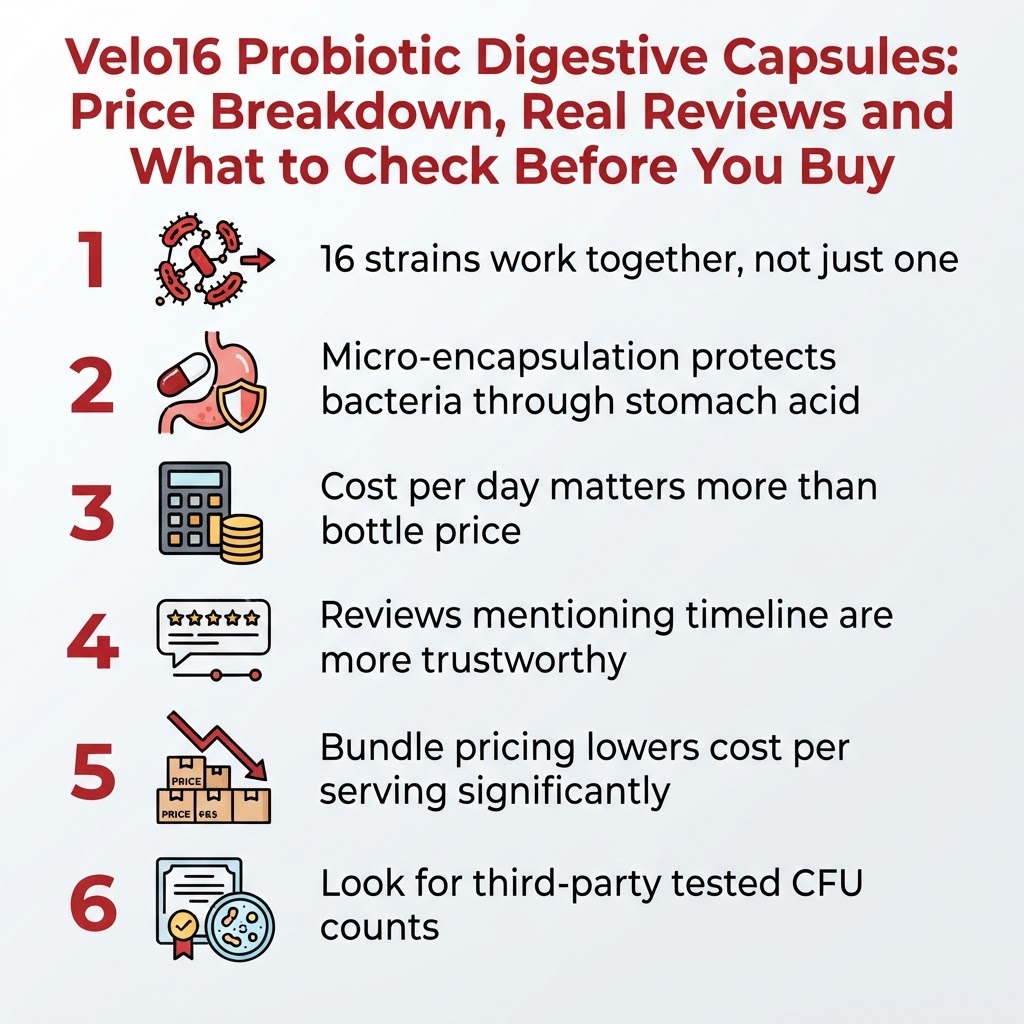
Velo16 is formulated with 16 distinct probiotic strains, rather than the one or two strains found in most supermarket-shelf products. The idea behind multi-strain formulations is that different bacteria support different functions — some are associated with gas and bloating reduction, others with regularity, and others with supporting immune signalling in the gut lining.
Micro-Encapsulation: Why It Affects What You're Paying For
A major portion of the cost in any quality probiotic goes into the delivery technology, not just the bacteria itself. Velo16 uses a patented micro-encapsulation process designed to help protect live strains from stomach acid, so more organisms theoretically survive the trip to the intestines where they're meant to do their work.
Survivability through gastric transit is one of the most overlooked factors in probiotic efficacy — a strain's benefit is irrelevant if it doesn't arrive alive in sufficient numbers.
- International Scientific Association for Probiotics and Prebiotics (ISAPP), consensus guidance
This is a key reason multi-strain, encapsulated formulas tend to sit at a higher price point than basic single-strain capsules — the manufacturing process is more involved.
Velo16 Pricing Explained: Single Bottles, Bundles and Cost Per Day
Pricing on Velo16's own site (velobiotics.com) is structured around volume, with the cost per capsule dropping as you buy more. Below is a general breakdown of how the pricing tiers typically work for daily-use supplements like this:
Single Bottle
- Highest price per capsule — best for first-time trial users testing tolerance.
- Usually covers roughly a one-month supply at standard dosing.
3-Bottle Bundle
- Lower cost per bottle than single purchases, aimed at the 60-90 day window most gut-health practitioners suggest for noticing meaningful change.
- Often the most commonly reordered option based on review patterns.
Subscription or Auto-Renew Options
- Typically the lowest cost per day, since the brand prices convenience and retention at a discount.
- Worth it only if you've already confirmed the formula agrees with your digestion.
Because pricing promotions shift periodically, the most accurate up-to-date numbers will always be on the official Velobiotics product collection page rather than third-party resellers, where pricing can be inconsistent or outdated.
What Real Customer Reviews Say About Bloating After Meals
When you filter through reviews specifically mentioning post-meal bloating, a few consistent patterns tend to emerge — and they're worth reading critically rather than at face value.
Positive Patterns in Reviews
- Many reviewers report noticing a difference in bloating and heaviness after two to four weeks of consistent use, not immediately.
- Several mention pairing the capsules with smaller, slower meals for better results.
- A recurring theme is reduced afternoon sluggishness alongside less visible bloating, which lines up with the gut-energy connection we explored in our piece on hidden gut-energy links.
Common Complaints or Mixed Reviews
- Some users report mild initial gas or adjustment symptoms in the first week — a known, generally temporary response reported with many multi-strain probiotics.
- A smaller number of reviewers note no noticeable change, often in cases where diet and stress factors were not addressed alongside supplementation.
- Shipping times and stock availability come up occasionally, which is a logistics issue rather than a product efficacy one.
Response to probiotic supplementation varies significantly between individuals due to differences in baseline microbiota composition, diet and lifestyle.
- Mayo Clinic, Digestive Health Expert Answers
This variability is completely normal and is one reason clinical researchers caution against expecting identical results from person to person. You can read more on this from the Mayo Clinic's overview on probiotics.
How to Read Probiotic Reviews Critically
Not all reviews carry equal weight. Before letting a star rating sway your decision, it helps to check for a few specific details.
- Timeline mentioned: Reviews referencing a 2-4 week period are generally more credible than "overnight miracle" claims, since microbiome shifts take time.
- Specificity: "Less bloated after dinner" is more useful than a vague five-star rating with no detail.
- Context: Look for mentions of diet changes alongside supplement use — these affect outcomes independently.
- Verified purchase tags: Prioritise reviews confirmed as actual buyers over anonymous comments.
For background on the biology behind why multi-strain formulas are gaining attention over single-strain products, our deep dive on how 16 probiotic strains transform digestive health is a useful companion read.
Velo16 vs Generic Single-Strain Probiotics: Price-to-Value Comparison
It's tempting to compare a R150 supermarket probiotic directly against a multi-strain capsule priced higher — but the comparison isn't quite apples to apples.
- Strain diversity: Single-strain products target one mechanism; 16-strain formulas are designed to support multiple digestive and microbial functions simultaneously.
- Delivery technology: Basic capsules without protective coating may lose a large portion of live cultures to stomach acid before reaching the gut.
- Cost per surviving CFU: A cheaper bottle with poor survivability may actually cost more per