
Why You're Always Tired: The Hidden Gut-Energy Connection Most Doctors Miss
By Dr. Chomba Chuma, MD | Velo16™ Health Journal
You've had your bloods done. Your iron is "normal." Your thyroid is "fine." Your doctor says everything looks okay — yet you're still dragging yourself out of bed every morning, reaching for your third cup of coffee by 11am, and collapsing on the couch by 7pm. Sound familiar? If so, you're not imagining it. And you're certainly not alone.
Persistent, unexplained fatigue is one of the most common complaints I hear in my functional medicine practice. Millions of South Africans — and indeed adults globally — live with a constant, grinding exhaustion that never fully lifts, no matter how much they sleep. Conventional medicine too often labels this as stress, depression, or simply "getting older." But after years of clinical practice and diving deep into the research on gut health fatigue, I've come to understand that the answer frequently lies somewhere most doctors never think to look: your gut.
In this article, I'm going to walk you through the science connecting your gut microbiome to your energy levels, explain how gut dysbiosis quietly steals your vitality through nutrient malabsorption and B-vitamin deficiency, and show you exactly how restoring microbial balance — alongside targeted supplementation — can bring your energy back to life. This is the gut-energy connection most doctors miss, and it's time you knew about it.
The Energy Crisis Hidden in Your Gut
Let's start with a fundamental truth that most of us were never taught: your gut does far more than digest food. Your gastrointestinal tract is home to approximately 38 trillion microorganisms — bacteria, fungi, viruses, and other microbes — collectively known as the gut microbiome. This ecosystem is so metabolically active that scientists now refer to it as a "forgotten organ," one that influences everything from immune function and mood to — critically — energy production.
When your gut microbiome is in a state of balance (what we call eubiosis), it supports healthy digestion, efficient nutrient absorption, and the local synthesis of key vitamins. But when the balance tips — when harmful bacteria outcompete beneficial ones, when microbial diversity drops, when the intestinal lining becomes compromised — you enter a state of dysbiosis. And dysbiosis, the research now clearly shows, is a direct contributor to chronic fatigue.
"The gut microbiome plays a fundamental role in energy homeostasis, and disruptions to microbial communities have been linked to metabolic dysfunction, inflammation, and persistent fatigue states." — Journal of Clinical Gastroenterology, 2018
A landmark study published in Nature Microbiology identified specific microbial signatures in patients with chronic fatigue syndrome, demonstrating that the condition was associated with measurable disruptions in the gut ecosystem. This wasn't a fringe finding — it was a paradigm shift. Chronic fatigue gut connections are real, they are physiological, and they are treatable.
What Causes Gut Dysbiosis in the First Place?
Before we talk solutions, it's worth understanding the common drivers of dysbiosis in the modern South African context:
- Antibiotic overuse: Antibiotics are life-saving, but they're indiscriminate — they kill beneficial bacteria alongside harmful ones. A single course can alter microbial diversity for months.
- Ultra-processed diets: Diets high in refined carbohydrates, seed oils, and food additives starve beneficial bacteria and feed pathogenic ones.
- Chronic stress: The gut-brain axis means that sustained psychological stress directly alters gut microbial composition.
- Alcohol consumption: Even moderate alcohol intake disrupts the gut lining and shifts microbial populations toward dysbiosis.
- Environmental toxins: Pesticide residues, heavy metals, and pollutants compromise both gut barrier integrity and microbial diversity.
- Low dietary fibre: Fibre is the primary fuel for beneficial gut bacteria. Without adequate fibre, these bacteria literally starve and decline.
If several of these resonate with your lifestyle — and for most busy, modern adults they will — your gut microbiome may well be compromised, and this compromise may be the silent engine driving your fatigue.
How a Disrupted Gut Steals Your Energy: The Nutrient Malabsorption Connection
One of the most direct pathways between gut dysbiosis and gut health fatigue is through impaired nutrient absorption. Here's how it works.
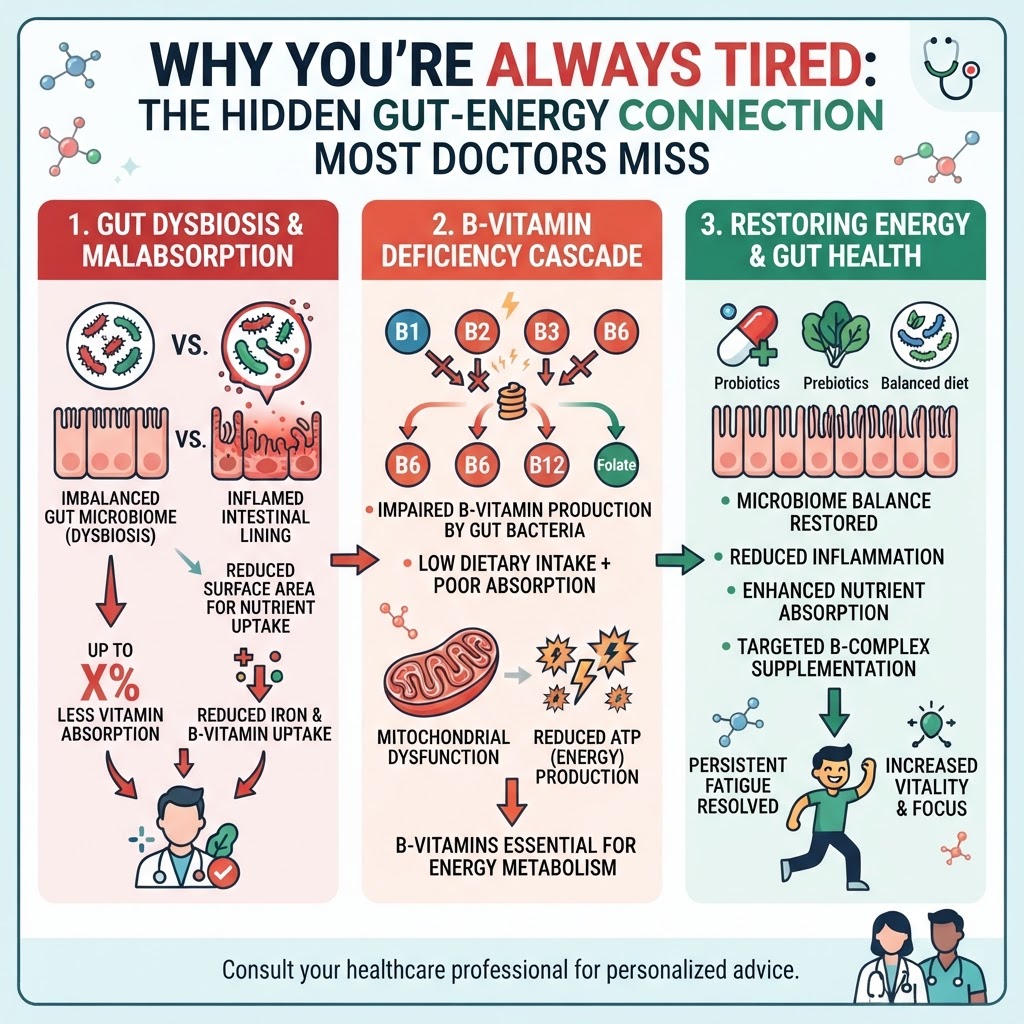
Your small intestine is lined with millions of tiny finger-like projections called villi. These villi dramatically increase the surface area available for nutrient absorption — in a healthy gut, this surface area is roughly the size of a tennis court. But when dysbiosis takes hold, it triggers low-grade intestinal inflammation, and the structural integrity of the gut lining begins to deteriorate. The tight junctions between intestinal cells loosen — a condition colloquially known as "leaky gut" (or intestinal hyperpermeability, in clinical terms).
The consequences of this are significant. Not only does a compromised gut barrier allow undigested food particles and bacterial toxins to enter the bloodstream (triggering systemic inflammation), but it also impairs the selective absorption of micronutrients. Iron, magnesium, zinc, and critically — the B vitamins — fail to be absorbed in adequate quantities.
"Impaired intestinal permeability and chronic low-grade inflammation are now recognised as key mechanisms linking gut microbiome dysfunction to systemic nutrient deficiencies and fatigue." — Harvard Health Publishing
The Inflammation-Energy Drain Cycle
Gut-derived inflammation compounds the fatigue problem in another important way. When the immune system is chronically activated — even at low levels — it consumes enormous amounts of energy. Inflammatory cytokines, the chemical messengers of immune activity, have been shown to directly influence the brain pathways that regulate energy, motivation, and mood. This is sometimes called sickness behaviour — that heavy, foggy, "can't get off the couch" feeling that mirrors a bad flu, but experienced at a lower level, chronically, day after day.
This is why so many people with gut dysbiosis describe their fatigue as distinctly different from normal tiredness — it has a quality of physical heaviness, brain fog, and motivational blunting that sleep alone cannot resolve.
The B-Vitamin-Energy Link: Why Your Gut is Your Primary B-Vitamin Factory
This is where the story becomes particularly important — and where many conventional medicine approaches fall short. When we talk about B vitamins energy, we're referring to a family of eight water-soluble vitamins that are absolutely central to every cell's ability to produce energy.
The B vitamins — B1 (thiamine), B2 (riboflavin), B3 (niacin), B5 (pantothenic acid), B6 (pyridoxine), B7 (biotin), B9 (folate), and B12 (cobalamin) — are the essential cofactors for the biochemical processes that convert food into ATP, the body's primary energy currency. Without adequate B vitamins, the mitochondria — your cells' power plants — simply cannot function efficiently. The result is cellular energy failure, experienced subjectively as profound, persistent fatigue.
"B-vitamin deficiencies are among the most common nutritional insufficiencies worldwide and represent a significant contributor to unexplained fatigue and neurological symptoms." — World Health Organization
Your Gut Bacteria Synthesise B Vitamins — Or They Should
Here's the piece that almost no one talks about: a healthy gut microbiome is itself a B-vitamin production facility. Specific strains of beneficial bacteria — including Lactobacillus and Bifidobacterium species — synthesise meaningful quantities of B12, folate, B2, B6, B7, and B3 locally in the gut. These bacterially-produced vitamins contribute to your overall B-vitamin status alongside what you obtain from your diet.
When dysbiosis reduces populations of these beneficial bacteria, your endogenous B-vitamin production drops. Combined with impaired absorption through a compromised gut lining, this creates the perfect storm: you're producing less, absorbing less, and your energy systems are paying the price.
Signs Your B-Vitamin Status May Be Compromised
- Persistent fatigue that doesn't respond to rest
- Brain fog, difficulty concentrating, and poor memory
- Tingling or numbness in the hands and feet (a classic B12 deficiency sign)
- Mood disturbances, including irritability and low mood
- Cracks at the corners of the mouth (angular cheilitis — associated with B2/B3 deficiency)
- Pale or yellowish skin tone
- Muscle weakness and reduced exercise tolerance
If several of these describe your experience, it's worth considering whether gut-mediated B-vitamin deficiency may be at play — especially if conventional blood tests have come back "normal." Standard serum B12 testing, for example, is notoriously insensitive to functional B12 deficiency at the cellular level.
Probiotics for Energy: How Restoring Gut Balance Revives Vitality
So if gut dysbiosis is driving nutrient malabsorption, B-vitamin deficiency, and inflammation — all of which deplete energy — then restoring gut balance is a logical and evidence-based strategy for recovering vitality. This is where probiotic for energy supplementation enters the picture, and the science here is compelling.
Probiotics are live microorganisms that, when administered in adequate amounts, confer a health benefit on the host. Specifically, multi-strain probiotic formulas containing clinically studied Lactobacillus and Bifidobacterium species have been shown to:
- Reduce intestinal permeability — helping to heal the leaky gut that impairs nutrient absorption
- Lower systemic inflammatory markers — including CRP and pro-inflammatory cytokines that drive fatigue
- Restore microbial diversity — reintroducing the beneficial bacteria responsible for local B-vitamin synthesis
- Improve mitochondrial function — emerging research suggests certain probiotic metabolites directly support cellular energy production
- Modulate the gut-brain axis — reducing the neuroinflammatory signals that manifest as brain fog and low motivation
A systematic review published on NCBI/PubMed examining probiotic interventions in fatigue-related conditions found significant improvements in energy levels, cognitive function, and quality of life in participants receiving multi-strain probiotic supplementation compared to placebo. These were not trivial effects — participants reported meaningful, functional improvements in daily energy and wellbeing.
Why Probiotics Alone Aren't Always Enough
Here's the clinical nuance that I always emphasise with my patients: while restoring the microbiome is foundational, if you've been in a state of dysbiosis for months or years, your B-vitamin stores are likely already significantly depleted. In this situation, gut restoration alone — while essential — may not replenish deficiencies quickly enough to resolve fatigue in the short term.
This is why a dual-pronged approach is so effective: restore the gut while simultaneously replenishing B-vitamin stores through targeted supplementation. Address the root cause and the deficiency simultaneously. This is precisely the logic behind the Velo16™ approach to energy and vitality.
The Velo16™ Solution: Synergistic Gut and Energy Support
At Velo16™, we've built our Velo16™ Energy & Vitality Collection on exactly this dual-pathway principle. Because persistent fatigue is rarely a single-cause problem, our approach addresses it from multiple evidence-based angles simultaneously.
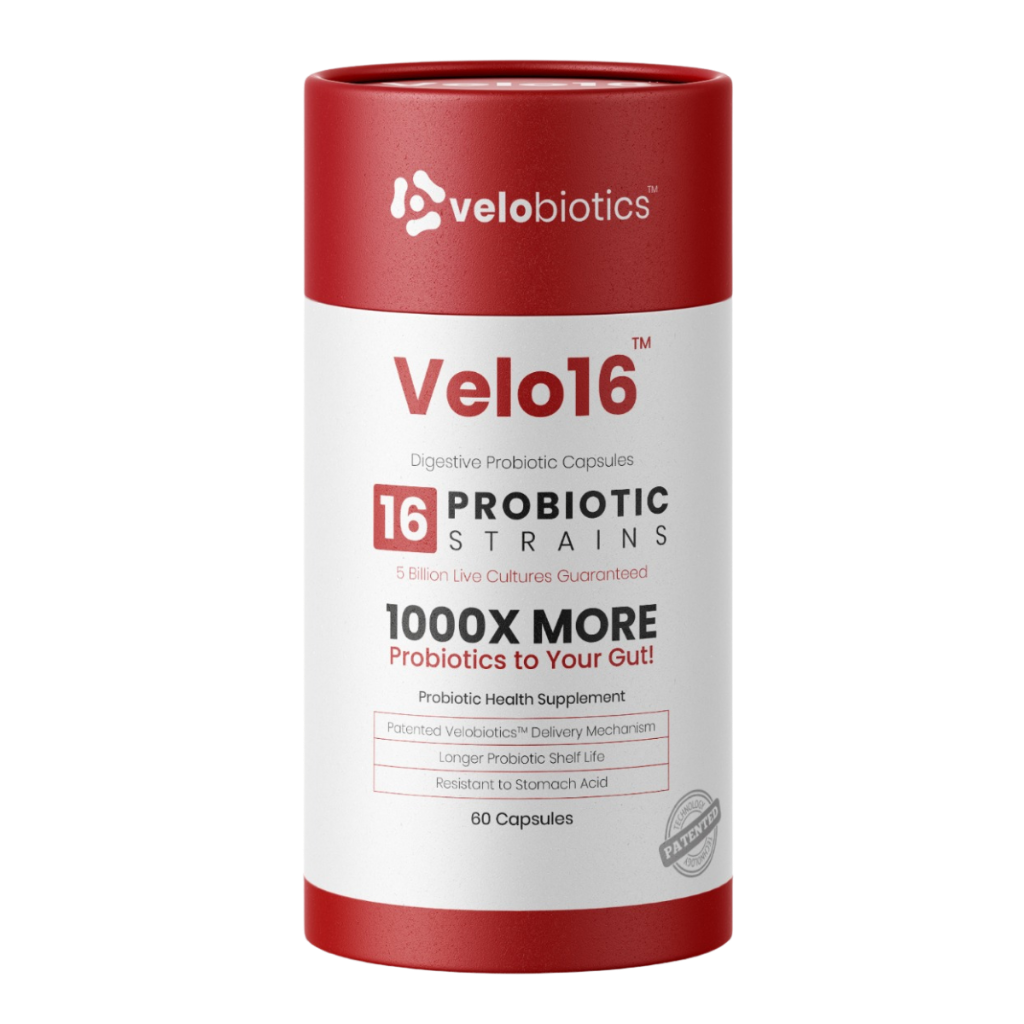
Velo16™ Probiotics: Restoring the Foundation
Our probiotic formulation is designed to deliver clinically meaningful doses of multi-strain beneficial bacteria, specifically selected to:
- Survive the acidic environment of the stomach and reach the intestines in viable numbers
- Support restoration of intestinal barrier integrity
- Reintroduce the B-vitamin-synthesising bacterial strains most commonly lost during dysbiosis
- Reduce gut-derived inflammation
- Support the gut-brain axis, improving the cognitive and motivational dimensions of fatigue
Every formulation decision we make at Velo16™ is grounded in peer-reviewed science. You can explore the full evidence base behind our approach at The Velo16™ Science page, where we transparently reference the research underpinning our formulations.
Velo16™ B-Complex Energy: Filling the Deficiency Gap
Our B-complex supplement delivers the complete family of B vitamins in their most bioavailable, active forms — not the cheaper synthetic forms that many products use, which require additional metabolic conversion steps that a compromised gut may struggle with. This matters enormously in clinical practice.
Key features of our B-Complex Energy formula:
- Methylcobalamin (active B12) rather than cyanocobalamin — directly usable by cells without conversion
- Methylfolate (active folate) rather than folic acid — essential for the significant portion of the population with MTHFR gene variants that impair folate conversion
- Full-spectrum B-complex — all eight B vitamins, because they work synergistically and deficiency in one affects the function of others
- Therapeutic dosing — not the token doses found in many grocery-store multivitamins
As a proudly South African brand, we've formulated our products with the specific nutritional gaps common in the South African context in mind. If you're looking for a quality energy supplement South Africa that actually addresses root causes rather than just masking symptoms, this is the approach that sets Velo16™ apart. Browse the full range when you Shop All Velo16™ Products.
The Timeline: What to Realistically Expect
I want to be honest with you, because functional medicine is about real results, not hype. Gut healing takes time. Here's a realistic timeline based on clinical experience and published research:
- Weeks 1-2: Initial gut microbiome shifts begin. Some patients notice improved digestion and reduced bloating first. B-complex supplementation begins supporting cellular energy almost immediately.
- Weeks 3-4: Many patients begin noticing improved energy, particularly in the afternoon when the "energy crash" is typically most pronounced.
- Months 2-3: Meaningful improvements in gut barrier integrity, reduced brain fog, more sustained energy, and improved sleep quality — all interconnected.
- Months 4-6: For those with significant dysbiosis and long-standing deficiencies, this is when the deeper restorative work really consolidates. Many patients describe feeling "like themselves again" for the first time in years.
Patience and consistency are the price of admission for genuine gut healing — and the dividend is sustainable, long-term energy rather than the artificial, cortisol-spiking stimulation of caffeine and energy drinks.
Lifestyle Pillars That Amplify Your Results
Supplementation is a powerful catalyst, but it works best as part of a broader lifestyle strategy. In my practice, I always emphasise these supporting pillars alongside Velo16™ supplementation:
1. Feed Your Microbiome: Dietary Foundations
- Prioritise diverse plant foods — aim for 30 different plant varieties per week to maximise microbial diversity
- Include fermented foods daily: plain yoghurt, kefir, sauerkraut, kimchi — all support beneficial bacterial populations
- Reduce ultra-processed foods and added sugars, which selectively feed pathogenic bacteria
- Ensure adequate protein intake to support gut lining repair and B-vitamin metabolism
2. Stress Management: Protecting the Gut-Brain Axis
Chronic stress is one of the most potent drivers of gut dysbiosis. Even 10 minutes of daily mindfulness practice, regular outdoor exercise, or adequate social connection measurably reduces the stress-mediated gut disruption that perpetuates fatigue cycles.
3. Sleep Optimisation: The Circadian-Gut Connection
Gut bacteria follow circadian rhythms. Irregular sleep patterns directly disrupt microbial populations. Prioritising 7-9 hours of quality sleep isn't optional — it's a biological requirement for gut health and energy recovery.
4. Hydration
Even mild dehydration impairs B-vitamin transport and utilisation. Aim for 2-2.5 litres of clean water daily — more if you're physically active or in a hot climate, as many South Africans are.
For those curious whether other aspects of gut health — like skin — might also be affected by your microbiome status, I'd encourage you to Take the Clear Skin Quiz — the gut-skin axis is another fascinating dimension of microbiome health that we explore throughout the Velo16™ Health Journal.
Frequently Asked Questions
Can gut problems really cause fatigue, or is this just a wellness trend?
This is not a trend — it's established science. Peer-reviewed research published in journals including Nature Microbiology and the Journal of Clinical Gastroenterology has confirmed measurable links between gut dysbiosis, nutrient malabsorption, systemic inflammation, and chronic fatigue states. The gut microbiome's role in energy metabolism is now a mainstream area of academic research, not fringe wellness theory. That said, persistent fatigue always warrants a thorough medical evaluation to rule out other causes — gut health is often a missing piece, but it should be investigated alongside, not instead of, conventional medical assessment.
How do I know if I have gut dysbiosis?
Common signs include persistent bloating, irregular bowel habits (constipation, diarrhoea, or alternating between the two), food intolerances, chronic fatigue, brain fog, skin issues like acne or eczema, frequent illness, and mood disturbances. Functional stool testing (comprehensive microbiome analysis) can provide a more detailed picture. In my practice, I often find that patients who've had years of unexplained fatigue show clear dysbiosis markers on microbiome testing. If several of these symptoms resonate, it's worth exploring gut health as a contributing factor with a qualified healthcare provider.
Why choose a B-complex supplement rather than just eating more B-vitamin-rich foods?
Diet should always be the foundation, and I strongly encourage B-vitamin-rich foods including meat, eggs, legumes, leafy greens, and fortified foods. However, if you have gut dysbiosis, your ability to absorb dietary B vitamins is compromised — so even an excellent diet may not deliver adequate B vitamins at the cellular level. Therapeutic supplementation with active forms of B vitamins (like methylcobalamin and methylfolate) bypasses some of these absorption challenges and replenishes stores more rapidly while the underlying gut restoration work proceeds. Once gut health is restored, dietary sources become sufficient for maintenance in most cases.
How long should I take Velo16™ Probiotics and B-Complex Energy?
For meaningful gut restoration and B-vitamin repletion, I generally recommend a minimum of 3-6 months of consistent supplementation. Significant dysbiosis doesn't develop overnight, and it doesn't resolve overnight either. After the initial restorative phase, many people transition to a maintenance dose of probiotics long-term, as ongoing lifestyle factors mean the gut benefits from continued support. The B-complex can often be reduced or maintained at a lower dose once deficiencies are corrected and gut absorption is restored. I always recommend reassessing with a healthcare provider after the initial treatment period.
Are Velo16™ products safe to take with medications?
Velo16™ products are formulated to the highest safety standards, and probiotics and B-vitamins are generally very well tolerated. However, if you are on prescription medications — particularly immunosuppressants, certain antibiotics, or medications for conditions like epilepsy or HIV — it is important to consult your prescribing doctor before starting any new supplement regimen. B12 supplementation can also affect the interpretation of certain blood tests. As always, supplements are most safely and effectively used as part of a comprehensive healthcare plan guided by a qualified medical professional.
Ready to Reclaim Your Energy? Start Here.
If you've recognised yourself in this article — the persistent fatigue, the brain fog, the sense that something is being missed — I want you to know that there is a pathway through this. The gut-energy connection is real, it is measurable, and it is addressable with the right targeted support.
At Velo16™, we've built a range of evidence-based supplements specifically designed to address the root causes of fatigue, not just the symptoms. Our Probiotics and B-Complex Energy work synergistically to restore your gut, replenish your B vitamins, and rebuild your vitality from the inside out.
- 🔬 Explore the full collection: Velo16™ Energy & Vitality Collection
- 🛒 Ready to start? Shop All Velo16™ Products
- 📖 Dive deeper into the science: The Velo16™ Science
- 📝 Read more on gut health and wellbeing: Velo16™ Health Journal
Your energy is not gone — it's waiting to be restored. Let's do this together.